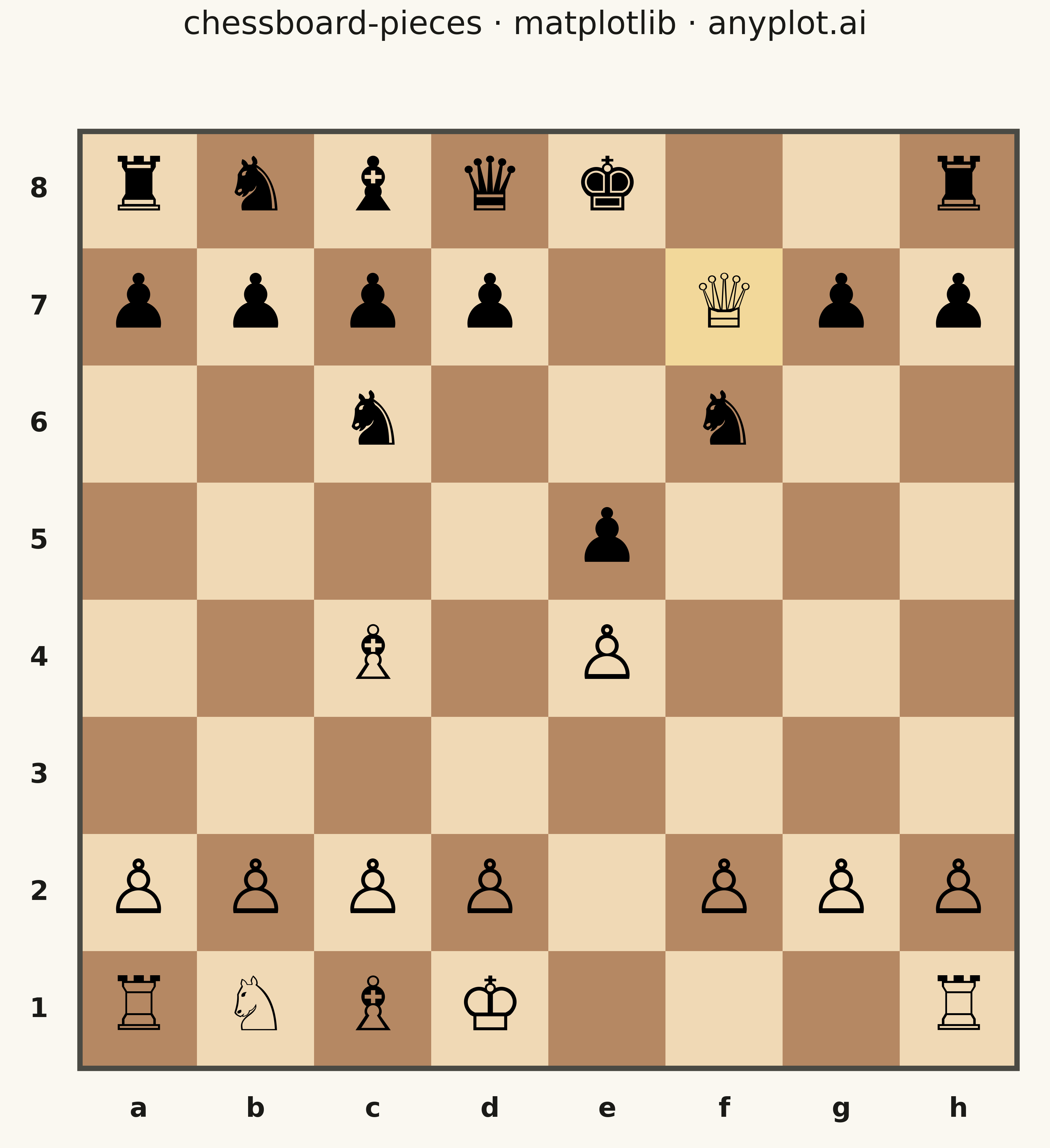
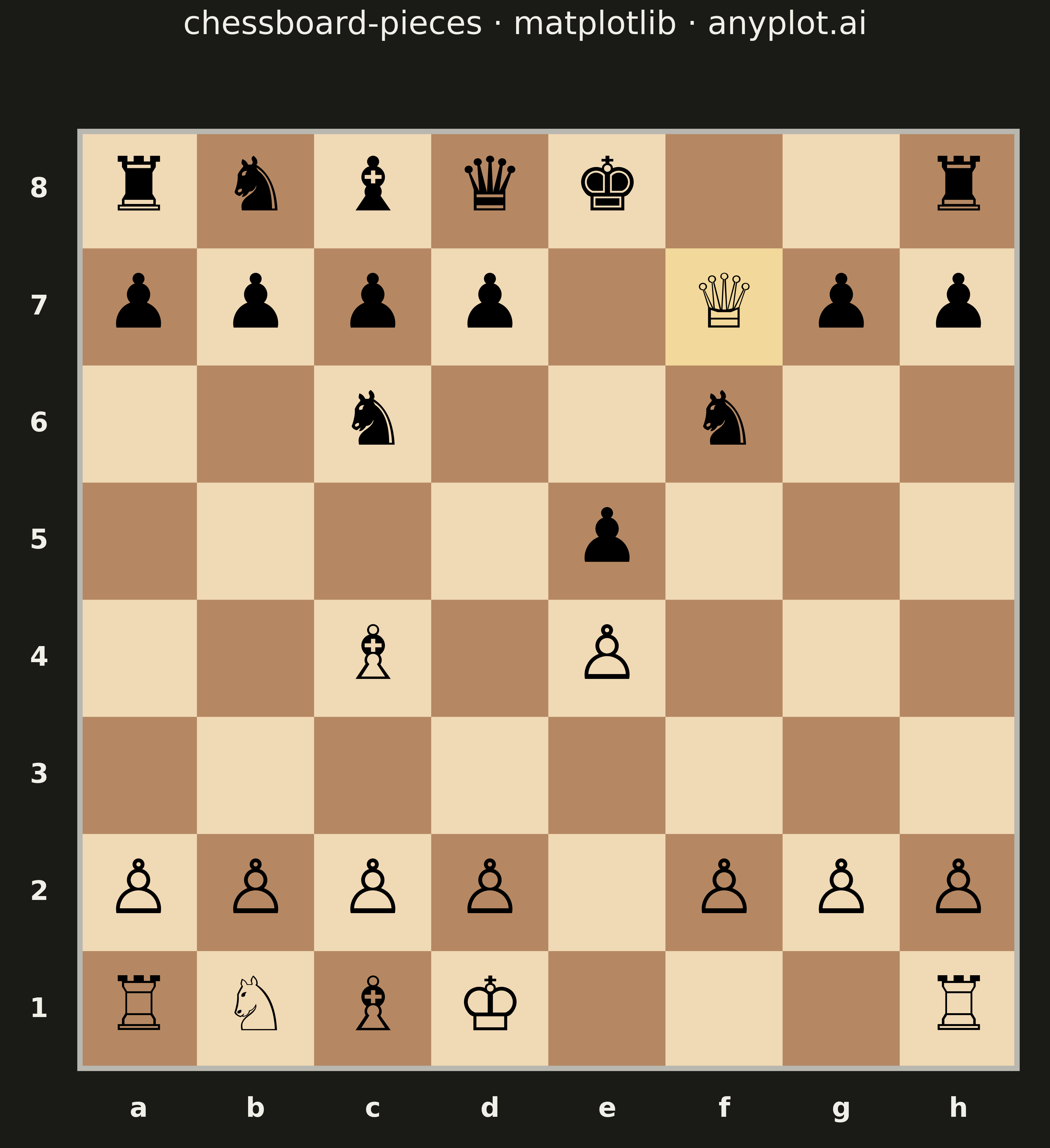
A chess board visualization with pieces that can be positioned programmatically to display specific game positions, puzzles, or notable games. Pieces are defined using a dictionary mapping squares (e.g., 'e4': 'K') to standard chess notation where uppercase letters represent white pieces (K/Q/R/B/N/P) and lowercase represent black pieces (k/q/r/b/n/p). Unicode chess symbols provide clean, recognizable piece rendering.
""" anyplot.ai
chessboard-pieces: Chess Board with Pieces for Position Diagrams
Library: matplotlib 3.10.9 | Python 3.13.13
Quality: 90/100 | Updated: 2026-05-17
"""

import os
import sys


# Workaround for module name conflict: ensure we import the actual matplotlib package
# by removing the current directory from sys.path temporarily
_original_path = sys.path[:]
_remove_items = ["", ".", os.path.dirname(__file__)]
sys.path = [p for p in sys.path if p not in _remove_items]

import matplotlib.patches as patches
import matplotlib.pyplot as plt


sys.path = _original_path

# Theme tokens
THEME = os.getenv("ANYPLOT_THEME", "light")
PAGE_BG = "#FAF8F1" if THEME == "light" else "#1A1A17"
INK = "#1A1A17" if THEME == "light" else "#F0EFE8"
INK_SOFT = "#4A4A44" if THEME == "light" else "#B8B7B0"
HIGHLIGHT = "#FFD700" if THEME == "light" else "#FFD700"  # Subtle gold for mate threat

# Unicode chess symbols
PIECE_SYMBOLS = {
    "K": "♔",  # White King
    "Q": "♕",  # White Queen
    "R": "♖",  # White Rook
    "B": "♗",  # White Bishop
    "N": "♘",  # White Knight
    "P": "♙",  # White Pawn
    "k": "♚",  # Black King
    "q": "♛",  # Black Queen
    "r": "♜",  # Black Rook
    "b": "♝",  # Black Bishop
    "n": "♞",  # Black Knight
    "p": "♟",  # Black Pawn
}

# Scholar's Mate position - a famous quick checkmate
# After 1.e4 e5 2.Bc4 Nc6 3.Qh5 Nf6?? 4.Qxf7#
pieces = {
    # White pieces
    "a1": "R",
    "b1": "N",
    "c1": "B",
    "d1": "K",
    "h1": "R",
    "a2": "P",
    "b2": "P",
    "c2": "P",
    "d2": "P",
    "f2": "P",
    "g2": "P",
    "h2": "P",
    "c4": "B",
    "e4": "P",
    "f7": "Q",
    # Black pieces
    "a8": "r",
    "b8": "n",
    "c8": "b",
    "d8": "q",
    "e8": "k",
    "h8": "r",
    "a7": "p",
    "b7": "p",
    "c7": "p",
    "d7": "p",
    "g7": "p",
    "h7": "p",
    "c6": "n",
    "e5": "p",
    "f6": "n",
}

# Create figure (square format for chessboard)
fig, ax = plt.subplots(figsize=(12, 12), facecolor=PAGE_BG)
ax.set_facecolor(PAGE_BG)

# Board colors (elegant chess board)
light_color = "#F0D9B5"  # Light squares
dark_color = "#B58863"  # Dark squares

# Draw board squares using patch collection for efficiency
squares = []
colors = []
for row in range(8):
    for col in range(8):
        color = light_color if (col + row) % 2 == 1 else dark_color
        rect = patches.Rectangle((col, row), 1, 1, linewidth=0, facecolor=color)
        ax.add_patch(rect)

# Highlight the mate threat (f7 - where white queen delivers checkmate)
mate_col, mate_row = 5, 6  # f7 in 0-indexed coordinates
highlight = patches.Rectangle((mate_col, mate_row), 1, 1, linewidth=0, facecolor=HIGHLIGHT, alpha=0.15, zorder=2)
ax.add_patch(highlight)

# Draw pieces using text (DejaVu Sans renders Unicode pieces well)
for square, piece in pieces.items():
    col = ord(square[0]) - ord("a")
    row = int(square[1]) - 1
    symbol = PIECE_SYMBOLS[piece]
    ax.text(col + 0.5, row + 0.5, symbol, fontsize=56, ha="center", va="center", fontfamily="DejaVu Sans", zorder=3)

# Add coordinate labels
file_labels = "abcdefgh"
rank_labels = "12345678"

for i in range(8):
    # File labels (a-h) at bottom
    ax.text(i + 0.5, -0.35, file_labels[i], fontsize=20, ha="center", va="center", fontweight="bold", color=INK)
    # Rank labels (1-8) on left
    ax.text(-0.35, i + 0.5, rank_labels[i], fontsize=20, ha="center", va="center", fontweight="bold", color=INK)

# Board border using custom patch
border = patches.Rectangle((0, 0), 8, 8, linewidth=4, edgecolor=INK_SOFT, facecolor="none", zorder=4)
ax.add_patch(border)

# Styling
ax.set_xlim(-0.6, 8.2)
ax.set_ylim(-0.6, 8.6)
ax.set_aspect("equal")
ax.axis("off")

# Title
ax.set_title("chessboard-pieces · matplotlib · anyplot.ai", fontsize=24, fontweight="medium", pad=20, color=INK)

plt.tight_layout()
plt.savefig(f"plot-{THEME}.png", dpi=300, bbox_inches="tight", facecolor=PAGE_BG)
Runnable source as JSON, for any HTTP client: https://api.anyplot.ai/specs/chessboard-pieces/matplotlib/code. Any spec id and library id listed in llms-full.txt fit the same URL shape; every URL below is complete and callable.
{
  "spec_id": "chessboard-pieces",
  "language": "python",
  "library": "matplotlib",
  "page": "https://anyplot.ai/chessboard-pieces/python/matplotlib",
  "hub": "https://anyplot.ai/chessboard-pieces",
  "code_json": "https://api.anyplot.ai/specs/chessboard-pieces/matplotlib/code",
  "spec_json": "https://api.anyplot.ai/specs/chessboard-pieces",
  "render_light_png": "https://storage.googleapis.com/anyplot-images/plots/chessboard-pieces/python/matplotlib/plot-light.png",
  "render_dark_png": "https://storage.googleapis.com/anyplot-images/plots/chessboard-pieces/python/matplotlib/plot-dark.png",
  "quality_score": 90.0,
  "license": "MIT",
  "guide": "https://anyplot.ai/llms.txt"
}
Part of Chess Board with Pieces for Position Diagrams on anyplot.ai.