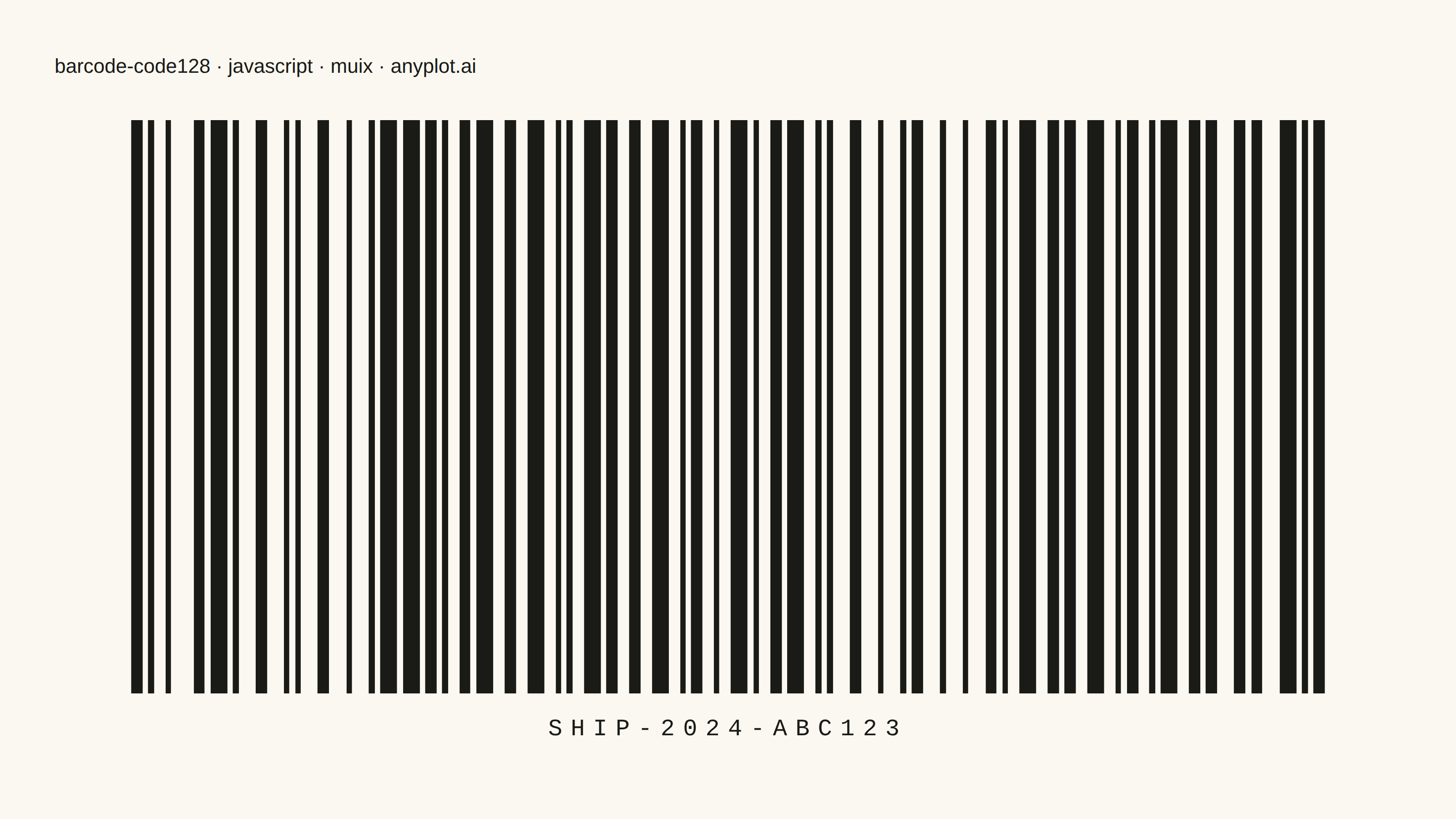
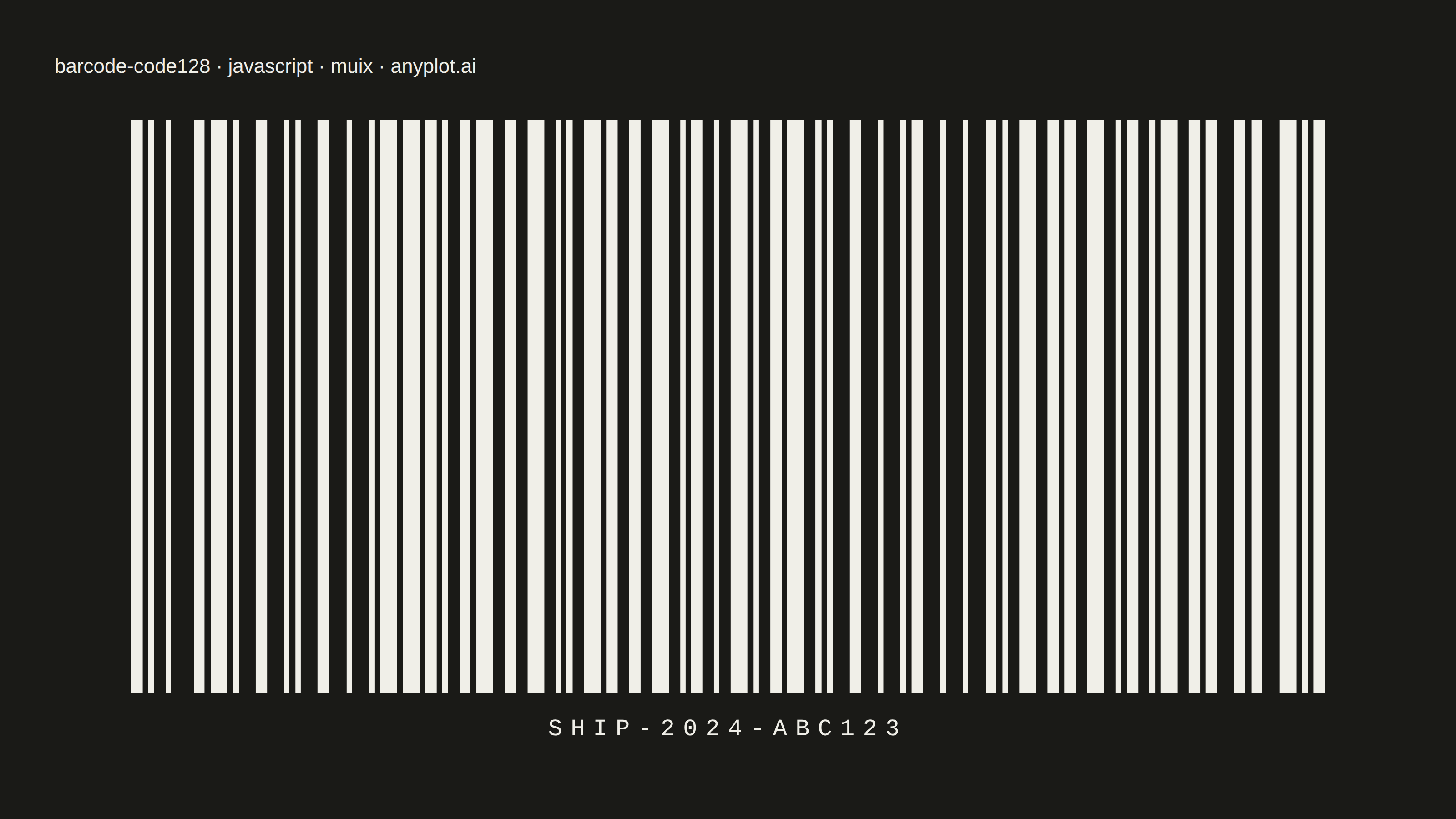
The same plot in 14 other libraries — JavaScript: Chart.js, D3.js, Apache ECharts, Highcharts; Python: Altair, Bokeh, lets-plot, Matplotlib, Plotly, plotnine, Pygal, Seaborn; R: ggplot2; Julia: Makie.jl. Compare all 15 side by side: Code 128 Barcode in Python, R, Julia and JavaScript.
A Code 128 barcode visualization that encodes alphanumeric data into a high-density linear barcode pattern. Code 128 is a widely-used 1D barcode format that supports the full 128 ASCII character set, with three code subsets (A, B, C) that can be switched dynamically for optimal encoding efficiency. This visualization generates scannable barcodes commonly found on shipping labels, industrial parts, and healthcare specimens.
// anyplot.ai
// barcode-code128: Code 128 Barcode
// Library: muix 7.29.1 | JavaScript 22.23.2
// Quality: 85/100 | Created: 2026-09-01
import { BarChart } from "@mui/x-charts/BarChart";

const t = window.ANYPLOT_TOKENS;
const SIZE = window.ANYPLOT_SIZE;

// --- Code 128 Subset B encoder (real ISO/IEC 15417 tables, not a mockup) ----
// BARS[v] is the real 11-module (13 for STOP) bar/space pattern for symbol
// value v, encoded as a string of 1s (bar) and 0s (space) — the canonical
// Code 128 symbol table. Index 103/104/105 are Start A/B/C, 106 is Stop.
const BARS = [
  11011001100, 11001101100, 11001100110, 10010011000, 10010001100, 10001001100, 10011001000, 10011000100,
  10001100100, 11001001000, 11001000100, 11000100100, 10110011100, 10011011100, 10011001110, 10111001100,
  10011101100, 10011100110, 11001110010, 11001011100, 11001001110, 11011100100, 11001110100, 11101101110,
  11101001100, 11100101100, 11100100110, 11101100100, 11100110100, 11100110010, 11011011000, 11011000110,
  11000110110, 10100011000, 10001011000, 10001000110, 10110001000, 10001101000, 10001100010, 11010001000,
  11000101000, 11000100010, 10110111000, 10110001110, 10001101110, 10111011000, 10111000110, 10001110110,
  11101110110, 11010001110, 11000101110, 11011101000, 11011100010, 11011101110, 11101011000, 11101000110,
  11100010110, 11101101000, 11101100010, 11100011010, 11101111010, 11001000010, 11110001010, 10100110000,
  10100001100, 10010110000, 10010000110, 10000101100, 10000100110, 10110010000, 10110000100, 10011010000,
  10011000010, 10000110100, 10000110010, 11000010010, 11001010000, 11110111010, 11000010100, 10001111010,
  10100111100, 10010111100, 10010011110, 10111100100, 10011110100, 10011110010, 11110100100, 11110010100,
  11110010010, 11011011110, 11011110110, 11110110110, 10101111000, 10100011110, 10001011110, 10111101000,
  10111100010, 11110101000, 11110100010, 10111011110, 10111101110, 11101011110, 11110101110, 11010000100,
  11010010000, 11010011100, 1100011101011,
];
const START_B = 104;
const STOP = 106;
const QUIET_ZONE_MODULES = 10; // ANSI/ISO minimum quiet zone: 10x module width

// Shipping-label content (Subset B: full ASCII 32-126, no subset switching needed).
const CONTENT = "SHIP-2024-ABC123";

const dataValues = Array.from(CONTENT, (ch) => ch.charCodeAt(0) - 32);
const checksum = dataValues.reduce((sum, v, i) => sum + v * (i + 1), START_B) % 103;
const symbolValues = [START_B, ...dataValues, checksum, STOP];

const moduleBits = symbolValues.map((v) => String(BARS[v])).join("");
const fullBits = "0".repeat(QUIET_ZONE_MODULES) + moduleBits + "0".repeat(QUIET_ZONE_MODULES);
const TOTAL_MODULES = fullBits.length;

// Run-length encode into bar/space segments — each becomes one stacked series
// so the chart draws the exact variable-width pattern, not an approximation.
const segments = [];
for (let i = 0; i < fullBits.length; ) {
  let j = i;
  while (j < fullBits.length && fullBits[j] === fullBits[i]) j++;
  segments.push({ width: j - i, isBar: fullBits[i] === "1" });
  i = j;
}

// --- Title chrome ------------------------------------------------------------
const TITLE = "barcode-code128 · javascript · muix · anyplot.ai";
const TITLE_FONT_DEFAULT = 22;
const titleFontSize =
  TITLE.length > 67 ? Math.round(TITLE_FONT_DEFAULT * (67 / TITLE.length)) : TITLE_FONT_DEFAULT;

// --- Layout constants (CSS px within the mount's coordinate space) ---------
const PADDING = 60;
const TITLE_H = 50;
const LABEL_H = 56;
const CAPTION_H = 28;
const GAP = 24;

// --- Chart (default-exported component — the harness mounts it) ------------
export default function Chart() {
  const chartHeight = SIZE.height - PADDING * 2 - TITLE_H - LABEL_H - CAPTION_H - GAP;
  const chartWidth = SIZE.width - PADDING * 2;

  return (
    <div
      style={{
        width: SIZE.width,
        height: SIZE.height,
        padding: PADDING,
        boxSizing: "border-box",
        display: "flex",
        flexDirection: "column",
      }}
    >
      <div style={{ height: TITLE_H, fontSize: titleFontSize, fontWeight: 500, color: t.ink }}>{TITLE}</div>
      <div style={{ height: GAP }} />
      <BarChart
        width={chartWidth}
        height={chartHeight}
        layout="horizontal"
        series={segments.map((seg) => ({
          data: [seg.width],
          stack: "barcode",
          // Bars behave like structural ink (a rendered glyph), not a
          // categorical series, so they take the theme-adaptive ink token
          // rather than the brand-green Imprint position — the module
          // widths themselves stay geometrically exact to real Code 128,
          // so the pattern would still scan if printed true black-on-white.
          color: seg.isBar ? t.ink : "transparent",
        }))}
        xAxis={[{ scaleType: "linear", min: 0, max: TOTAL_MODULES }]}
        yAxis={[{ scaleType: "band", data: ["code128"], categoryGapRatio: 0 }]}
        margin={{ top: 0, bottom: 0, left: 0, right: 0 }}
        bottomAxis={null}
        leftAxis={null}
        slotProps={{ legend: { hidden: true } }}
        tooltip={{ trigger: "none" }}
        skipAnimation
      />
      <div style={{ height: GAP }} />
      <div
        style={{
          height: LABEL_H,
          textAlign: "center",
          fontFamily: "'Courier New', monospace",
          fontSize: 26,
          letterSpacing: "0.35em",
          color: t.ink,
        }}
      >
        {CONTENT}
      </div>
      <div style={{ height: CAPTION_H, textAlign: "center", fontSize: 14, color: t.inkSoft }}>
        Code 128 · Subset B (full ASCII, ANSI/ISO quiet zones)
      </div>
    </div>
  );
}
Runnable source as JSON, for any HTTP client: https://api.anyplot.ai/specs/barcode-code128/muix/code. Any spec id and library id listed in llms-full.txt fit the same URL shape; every URL below is complete and callable.
{
  "spec_id": "barcode-code128",
  "language": "javascript",
  "library": "muix",
  "page": "https://anyplot.ai/barcode-code128/javascript/muix",
  "hub": "https://anyplot.ai/barcode-code128",
  "code_json": "https://api.anyplot.ai/specs/barcode-code128/muix/code",
  "spec_json": "https://api.anyplot.ai/specs/barcode-code128",
  "render_light_png": "https://storage.googleapis.com/anyplot-images/plots/barcode-code128/javascript/muix/plot-light.png",
  "render_dark_png": "https://storage.googleapis.com/anyplot-images/plots/barcode-code128/javascript/muix/plot-dark.png",
  "interactive_light_html": "https://storage.googleapis.com/anyplot-images/plots/barcode-code128/javascript/muix/plot-light.html",
  "interactive_dark_html": "https://storage.googleapis.com/anyplot-images/plots/barcode-code128/javascript/muix/plot-dark.html",
  "quality_score": 85.0,
  "license": "MIT",
  "guide": "https://anyplot.ai/llms.txt"
}
Part of Code 128 Barcode on anyplot.ai.