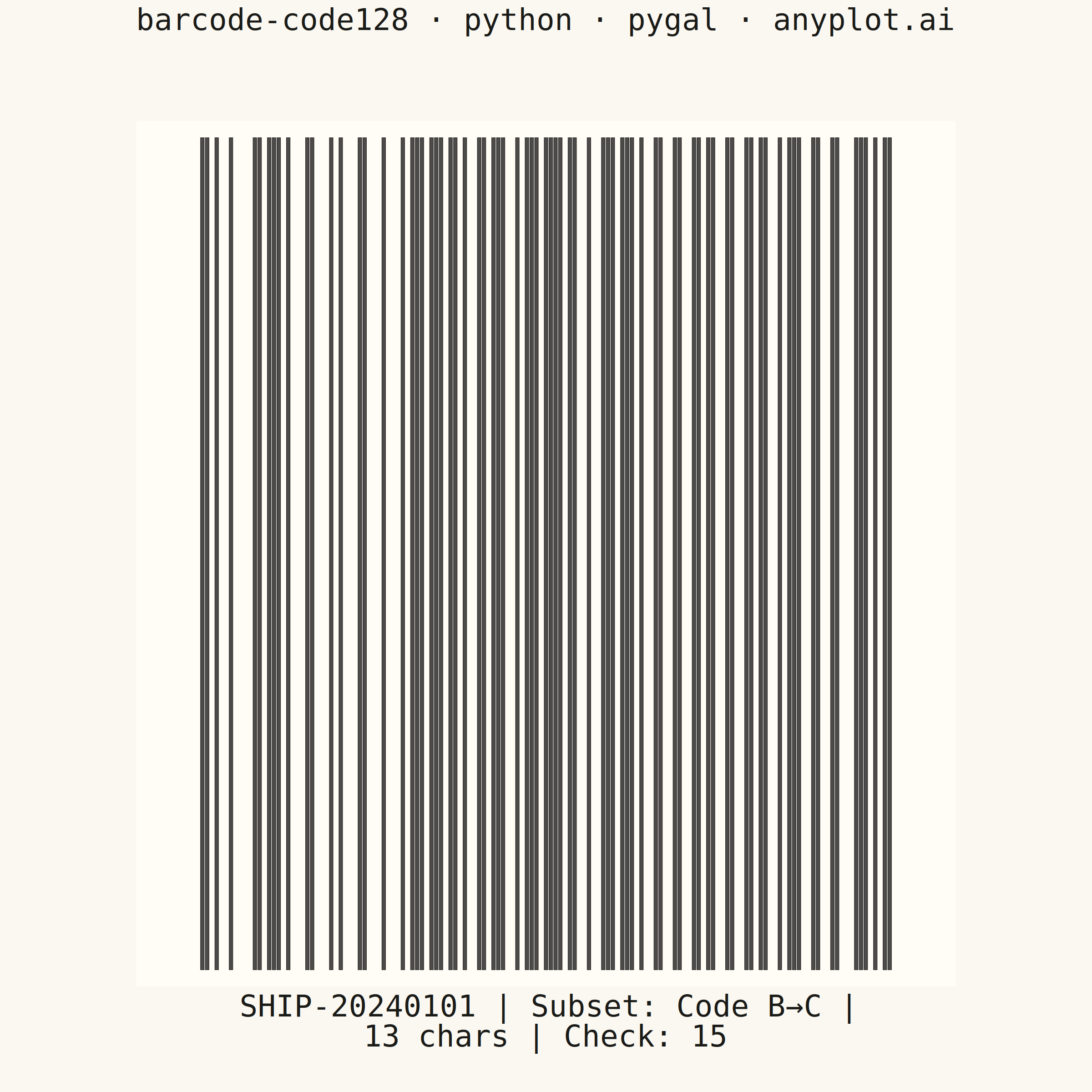
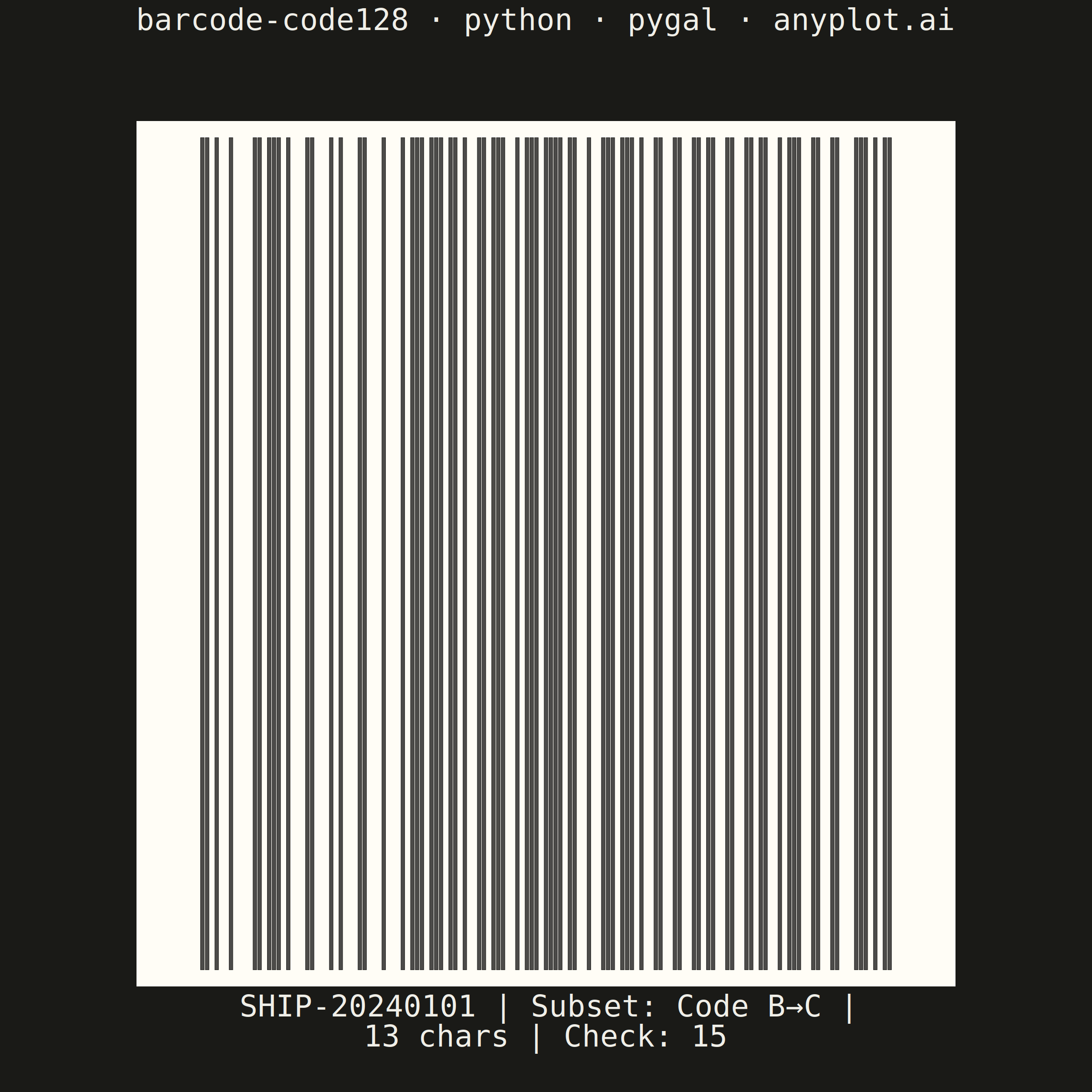
A Code 128 barcode visualization that encodes alphanumeric data into a high-density linear barcode pattern. Code 128 is a widely-used 1D barcode format that supports the full 128 ASCII character set, with three code subsets (A, B, C) that can be switched dynamically for optimal encoding efficiency. This visualization generates scannable barcodes commonly found on shipping labels, industrial parts, and healthcare specimens.
""" anyplot.ai
barcode-code128: Code 128 Barcode
Library: pygal 3.1.0 | Python 3.13.13
Quality: 87/100 | Updated: 2026-05-21
"""

import os

import pygal
from pygal.style import Style


THEME = os.getenv("ANYPLOT_THEME", "light")
PAGE_BG = "#FAF8F1" if THEME == "light" else "#1A1A17"
ELEVATED_BG = "#FFFDF6"  # barcode must stay on a light surface for scan reliability
INK = "#1A1A17" if THEME == "light" else "#F0EFE8"
INK_MUTED = "#6B6A63" if THEME == "light" else "#A8A79F"

# Code 128B character table: SP(0) through ~(94)
CODE128B_CHARS = " !\"#$%&'()*+,-./0123456789:;<=>?@ABCDEFGHIJKLMNOPQRSTUVWXYZ[\\]^_`abcdefghijklmnopqrstuvwxyz{|}~"

# 107 Code 128 bar/space patterns (indices 0-106); STOP (106) has 7 elements
CODE128_PATTERNS = [
    (2, 1, 2, 2, 2, 2),
    (2, 2, 2, 1, 2, 2),
    (2, 2, 2, 2, 2, 1),
    (1, 2, 1, 2, 2, 3),
    (1, 2, 1, 3, 2, 2),
    (1, 3, 1, 2, 2, 2),
    (1, 2, 2, 2, 1, 3),
    (1, 2, 2, 3, 1, 2),
    (1, 3, 2, 2, 1, 2),
    (2, 2, 1, 2, 1, 3),
    (2, 2, 1, 3, 1, 2),
    (2, 3, 1, 2, 1, 2),
    (1, 1, 2, 2, 3, 2),
    (1, 2, 2, 1, 3, 2),
    (1, 2, 2, 2, 3, 1),
    (1, 1, 3, 2, 2, 2),
    (1, 2, 3, 1, 2, 2),
    (1, 2, 3, 2, 2, 1),
    (2, 2, 3, 2, 1, 1),
    (2, 2, 1, 1, 3, 2),
    (2, 2, 1, 2, 3, 1),
    (2, 1, 3, 2, 1, 2),
    (2, 2, 3, 1, 1, 2),
    (3, 1, 2, 1, 3, 1),
    (3, 1, 1, 2, 2, 2),
    (3, 2, 1, 1, 2, 2),
    (3, 2, 1, 2, 2, 1),
    (3, 1, 2, 2, 1, 2),
    (3, 2, 2, 1, 1, 2),
    (3, 2, 2, 2, 1, 1),
    (2, 1, 2, 1, 2, 3),
    (2, 1, 2, 3, 2, 1),
    (2, 3, 2, 1, 2, 1),
    (1, 1, 1, 3, 2, 3),
    (1, 3, 1, 1, 2, 3),
    (1, 3, 1, 3, 2, 1),
    (1, 1, 2, 3, 1, 3),
    (1, 3, 2, 1, 1, 3),
    (1, 3, 2, 3, 1, 1),
    (2, 1, 1, 3, 1, 3),
    (2, 3, 1, 1, 1, 3),
    (2, 3, 1, 3, 1, 1),
    (1, 1, 2, 1, 3, 3),
    (1, 1, 2, 3, 3, 1),
    (1, 3, 2, 1, 3, 1),
    (1, 1, 3, 1, 2, 3),
    (1, 1, 3, 3, 2, 1),
    (1, 3, 3, 1, 2, 1),
    (3, 1, 3, 1, 2, 1),
    (2, 1, 1, 3, 3, 1),
    (2, 3, 1, 1, 3, 1),
    (2, 1, 3, 1, 1, 3),
    (2, 1, 3, 3, 1, 1),
    (2, 1, 3, 1, 3, 1),
    (3, 1, 1, 1, 2, 3),
    (3, 1, 1, 3, 2, 1),
    (3, 3, 1, 1, 2, 1),
    (3, 1, 2, 1, 1, 3),
    (3, 1, 2, 3, 1, 1),
    (3, 3, 2, 1, 1, 1),
    (3, 1, 4, 1, 1, 1),
    (2, 2, 1, 4, 1, 1),
    (4, 3, 1, 1, 1, 1),
    (1, 1, 1, 2, 2, 4),
    (1, 1, 1, 4, 2, 2),
    (1, 2, 1, 1, 2, 4),
    (1, 2, 1, 4, 2, 1),
    (1, 4, 1, 1, 2, 2),
    (1, 4, 1, 2, 2, 1),
    (1, 1, 2, 2, 1, 4),
    (1, 1, 2, 4, 1, 2),
    (1, 2, 2, 1, 1, 4),
    (1, 2, 2, 4, 1, 1),
    (1, 4, 2, 1, 1, 2),
    (1, 4, 2, 2, 1, 1),
    (2, 4, 1, 2, 1, 1),
    (2, 2, 1, 1, 1, 4),
    (4, 1, 3, 1, 1, 1),
    (2, 4, 1, 1, 1, 2),
    (1, 3, 4, 1, 1, 1),
    (1, 1, 1, 2, 4, 2),
    (1, 2, 1, 1, 4, 2),
    (1, 2, 1, 2, 4, 1),
    (1, 1, 4, 2, 1, 2),
    (1, 2, 4, 1, 1, 2),
    (1, 2, 4, 2, 1, 1),
    (4, 1, 1, 2, 1, 2),
    (4, 2, 1, 1, 1, 2),
    (4, 2, 1, 2, 1, 1),
    (2, 1, 2, 1, 4, 1),
    (2, 1, 4, 1, 2, 1),
    (4, 1, 2, 1, 2, 1),
    (1, 1, 1, 1, 4, 3),
    (1, 1, 1, 3, 4, 1),
    (1, 3, 1, 1, 4, 1),
    (1, 1, 4, 1, 1, 3),
    (1, 1, 4, 3, 1, 1),
    (4, 1, 1, 1, 1, 3),
    (4, 1, 1, 3, 1, 1),
    (1, 1, 3, 1, 4, 1),
    (1, 1, 4, 1, 3, 1),
    (3, 1, 1, 1, 4, 1),
    (4, 1, 1, 1, 3, 1),
    (2, 1, 1, 4, 1, 2),
    (2, 1, 1, 2, 1, 4),
    (2, 1, 1, 2, 3, 2),
    (2, 3, 3, 1, 1, 1, 2),  # STOP (106): 7 elements
]

# Special symbol indices
START_B = 104
CODE_C = 99  # switch to Code C (digit-pair encoding)
STOP = 106

# Content: alpha prefix in Code B, digit suffix in Code C (demonstrates subset switching)
alpha_part = "SHIP-"
digit_part = "20240101"
content = alpha_part + digit_part

# Encode: START_B → Code B chars → CODE_C switch → digit pairs → checksum → STOP
raw_values = [START_B]
for ch in alpha_part:
    raw_values.append(CODE128B_CHARS.index(ch))
raw_values.append(CODE_C)
for i in range(0, len(digit_part), 2):
    raw_values.append(int(digit_part[i : i + 2]))

checksum_val = raw_values[0]
for pos, v in enumerate(raw_values[1:], 1):
    checksum_val += pos * v
check_digit = checksum_val % 103

values = raw_values + [check_digit, STOP]

# Expand encoded values to bar-module widths
bar_pattern = []
for val in values:
    bar_pattern.extend(CODE128_PATTERNS[val])

# Build module heights: even idx = bar (100), odd idx = space (0), with quiet zones
quiet_zone = 10
bar_heights = [0] * quiet_zone
for idx, width in enumerate(bar_pattern):
    bar_heights.extend([100 if idx % 2 == 0 else 0] * width)
bar_heights.extend([0] * quiet_zone)

# Style — elevated warm-white panel for barcode area; outer bg follows theme
custom_style = Style(
    background=PAGE_BG,
    plot_background=ELEVATED_BG,
    foreground=INK,
    foreground_strong=INK,
    foreground_subtle=INK_MUTED,
    colors=("#000000",),
    title_font_size=66,
    label_font_size=56,
    major_label_font_size=44,
    legend_font_size=44,
    value_font_size=0,
    tooltip_font_size=0,
)

# Square canvas suits barcode layout; tight bottom margin eliminates dead space
chart = pygal.Bar(
    width=2400,
    height=2400,
    style=custom_style,
    show_legend=False,
    show_x_labels=False,
    show_y_labels=False,
    show_x_guides=False,
    show_y_guides=False,
    spacing=0,
    margin_top=200,
    margin_bottom=100,
    margin_left=300,
    margin_right=300,
    title="barcode-code128 · python · pygal · anyplot.ai",
    print_values=False,
    range=(0, 100),
)

chart.add("", bar_heights)
# Human-readable text + encoding metadata: content, subset path, char count, check digit
chart.x_title = f"{content}  |  Subset: Code B→C  |  {len(content)} chars  |  Check: {check_digit}"

chart.render_to_png(f"plot-{THEME}.png")
with open(f"plot-{THEME}.html", "wb") as f:
    f.write(chart.render())
Runnable source as JSON, for any HTTP client: https://api.anyplot.ai/specs/barcode-code128/pygal/code. Any spec id and library id listed in llms-full.txt fit the same URL shape; every URL below is complete and callable.
{
  "spec_id": "barcode-code128",
  "language": "python",
  "library": "pygal",
  "page": "https://anyplot.ai/barcode-code128/python/pygal",
  "hub": "https://anyplot.ai/barcode-code128",
  "code_json": "https://api.anyplot.ai/specs/barcode-code128/pygal/code",
  "spec_json": "https://api.anyplot.ai/specs/barcode-code128",
  "render_light_png": "https://storage.googleapis.com/anyplot-images/plots/barcode-code128/python/pygal/plot-light.png",
  "render_dark_png": "https://storage.googleapis.com/anyplot-images/plots/barcode-code128/python/pygal/plot-dark.png",
  "interactive_light_html": "https://storage.googleapis.com/anyplot-images/plots/barcode-code128/python/pygal/plot-light.html",
  "interactive_dark_html": "https://storage.googleapis.com/anyplot-images/plots/barcode-code128/python/pygal/plot-dark.html",
  "quality_score": 87.0,
  "license": "MIT",
  "guide": "https://anyplot.ai/llms.txt"
}
Part of Code 128 Barcode on anyplot.ai.