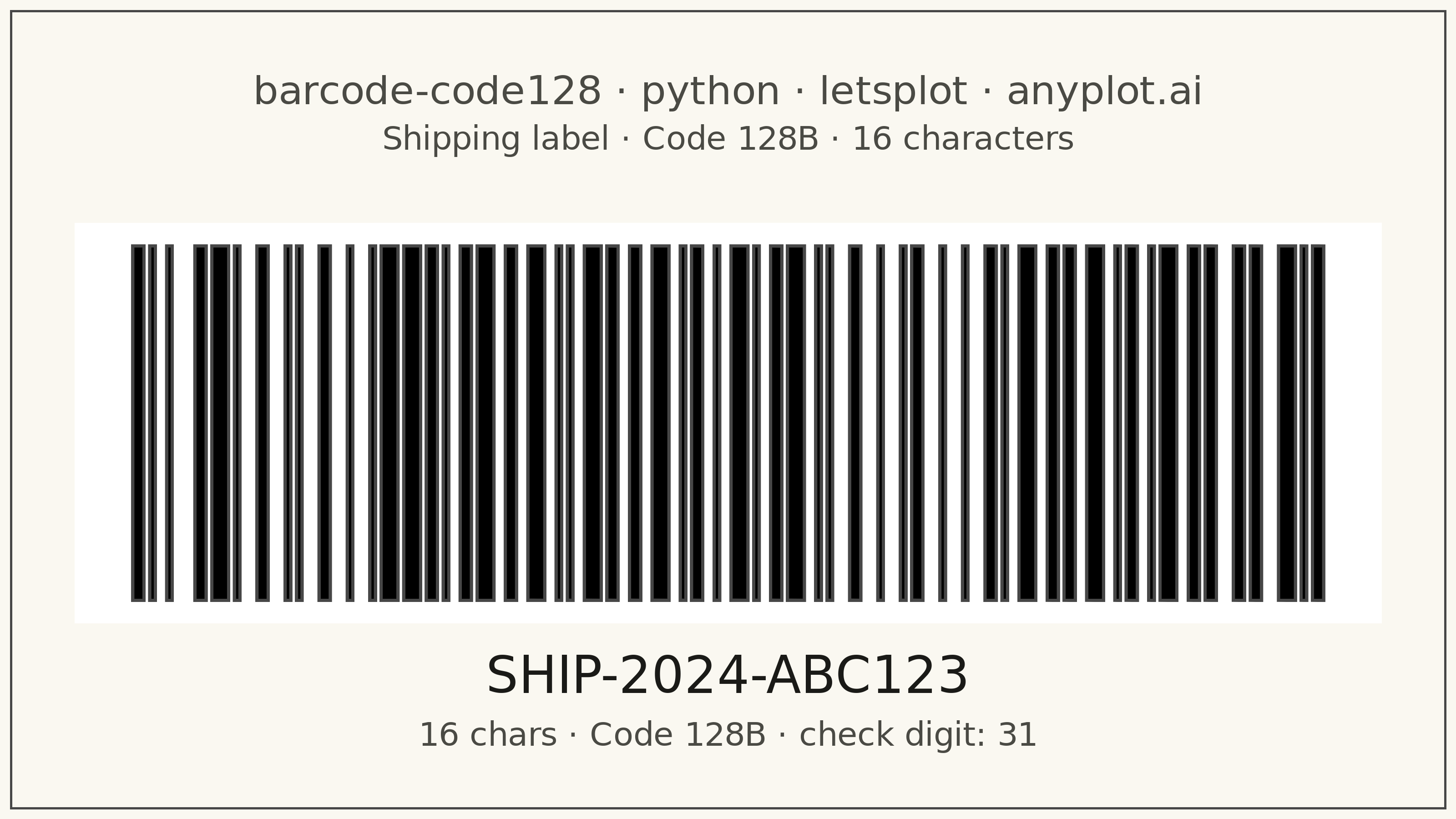
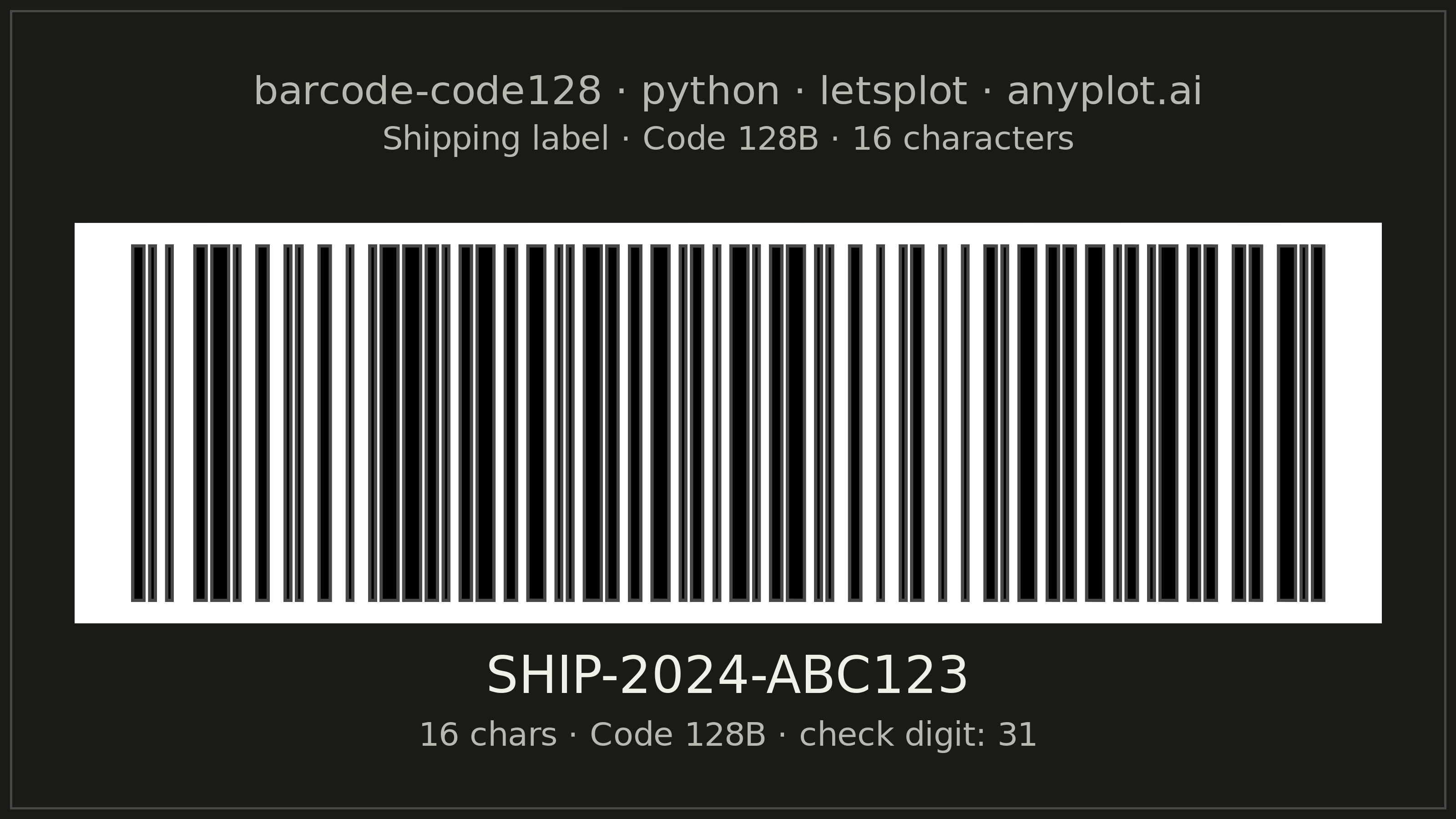
A Code 128 barcode visualization that encodes alphanumeric data into a high-density linear barcode pattern. Code 128 is a widely-used 1D barcode format that supports the full 128 ASCII character set, with three code subsets (A, B, C) that can be switched dynamically for optimal encoding efficiency. This visualization generates scannable barcodes commonly found on shipping labels, industrial parts, and healthcare specimens.
""" anyplot.ai
barcode-code128: Code 128 Barcode
Library: letsplot 4.10.1 | Python 3.13.13
Quality: 88/100 | Updated: 2026-05-21
"""

import os

import pandas as pd
from lets_plot import (
    LetsPlot,
    aes,
    element_rect,
    geom_rect,
    geom_text,
    ggplot,
    ggsave,
    ggsize,
    layer_tooltips,
    scale_fill_identity,
    theme,
    theme_void,
    xlim,
    ylim,
)


LetsPlot.setup_html()

THEME = os.getenv("ANYPLOT_THEME", "light")
PAGE_BG = "#FAF8F1" if THEME == "light" else "#1A1A17"
INK = "#1A1A17" if THEME == "light" else "#F0EFE8"
INK_SOFT = "#4A4A44" if THEME == "light" else "#B8B7B0"

# Code 128 encoding patterns: each digit is the width of alternating bar/space elements
CODE128_PATTERNS = {
    0: "212222",
    1: "222122",
    2: "222221",
    3: "121223",
    4: "121322",
    5: "131222",
    6: "122213",
    7: "122312",
    8: "132212",
    9: "221213",
    10: "221312",
    11: "231212",
    12: "112232",
    13: "122132",
    14: "122231",
    15: "113222",
    16: "123122",
    17: "123221",
    18: "223211",
    19: "221132",
    20: "221231",
    21: "213212",
    22: "223112",
    23: "312131",
    24: "311222",
    25: "321122",
    26: "321221",
    27: "312212",
    28: "322112",
    29: "322211",
    30: "212123",
    31: "212321",
    32: "232121",
    33: "111323",
    34: "131123",
    35: "131321",
    36: "112313",
    37: "132113",
    38: "132311",
    39: "211313",
    40: "231113",
    41: "231311",
    42: "112133",
    43: "112331",
    44: "132131",
    45: "113123",
    46: "113321",
    47: "133121",
    48: "313121",
    49: "211331",
    50: "231131",
    51: "213113",
    52: "213311",
    53: "213131",
    54: "311123",
    55: "311321",
    56: "331121",
    57: "312113",
    58: "312311",
    59: "332111",
    60: "314111",
    61: "221411",
    62: "431111",
    63: "111224",
    64: "111422",
    65: "121124",
    66: "121421",
    67: "141122",
    68: "141221",
    69: "112214",
    70: "112412",
    71: "122114",
    72: "122411",
    73: "142112",
    74: "142211",
    75: "241211",
    76: "221114",
    77: "413111",
    78: "241112",
    79: "134111",
    80: "111242",
    81: "121142",
    82: "121241",
    83: "114212",
    84: "124112",
    85: "124211",
    86: "411212",
    87: "421112",
    88: "421211",
    89: "212141",
    90: "214121",
    91: "412121",
    92: "111143",
    93: "111341",
    94: "131141",
    95: "114113",
    96: "114311",
    97: "411113",
    98: "411311",
    99: "113141",
    100: "114131",
    101: "311141",
    102: "411131",
    103: "211412",  # Start Code A
    104: "211214",  # Start Code B
    105: "211232",  # Start Code C
    106: "2331112",  # Stop (7 elements, 13 units)
}

# Code 128B maps ASCII 32–126 (printable chars) to values 0–94
CODE128B_CHARS = {chr(i + 32): i for i in range(95)}

# Data — shipping label barcode
content = "SHIP-2024-ABC123"

# Encode each character to its Code 128B symbol value
char_values = [CODE128B_CHARS.get(c, 0) for c in content]

# Checksum: start-B constant (104) plus each value weighted by position (1-indexed)
checksum = 104
for i, v in enumerate(char_values):
    checksum += v * (i + 1)
checksum = checksum % 103

# Full symbol sequence: start-B + data symbols + check digit + stop
sequence = [104] + char_values + [checksum, 106]

# Rasterize symbols into bar rectangles; spaces are implicit gaps
quiet_zone = 10
x_pos = quiet_zone
bar_ymin, bar_ymax = 32.0, 98.0
bars = []

for sym_idx, code in enumerate(sequence):
    if sym_idx == 0:
        sym_label = "Start Code B"
    elif sym_idx == len(sequence) - 1:
        sym_label = "Stop"
    elif sym_idx == len(sequence) - 2:
        sym_label = f"Check digit: {checksum}"
    else:
        char = content[sym_idx - 1]
        sym_label = f"'{char}'  pos {sym_idx}  Code 128B value {char_values[sym_idx - 1]}"
    is_bar = True
    for ch in CODE128_PATTERNS[code]:
        w = int(ch)
        if is_bar:
            bars.append(
                {
                    "xmin": float(x_pos),
                    "xmax": float(x_pos + w),
                    "ymin": bar_ymin,
                    "ymax": bar_ymax,
                    "fill": "#000000",
                    "symbol": sym_label,
                }
            )
        x_pos += w
        is_bar = not is_bar

total_width = x_pos + quiet_zone
cx = total_width / 2

df_bars = pd.DataFrame(bars)

# White background rectangle ensures barcode contrast on both light and dark themes
df_barcode_bg = pd.DataFrame(
    {
        "xmin": [0.0],
        "xmax": [float(total_width)],
        "ymin": [bar_ymin - 4.0],
        "ymax": [bar_ymax + 4.0],
        "fill": ["#FFFFFF"],
    }
)

df_text = pd.DataFrame({"x": [cx], "y": [18.0], "label": [content]})
df_annotation = pd.DataFrame(
    {"x": [cx], "y": [7.0], "label": [f"{len(content)} chars · Code 128B · check digit: {checksum}"]}
)
df_subtitle = pd.DataFrame(
    {"x": [cx], "y": [118.0], "label": [f"Shipping label · Code 128B · {len(content)} characters"]}
)
df_title = pd.DataFrame({"x": [cx], "y": [127.0], "label": ["barcode-code128 · python · letsplot · anyplot.ai"]})

# Plot
plot = (
    ggplot()
    + geom_rect(
        aes(xmin="xmin", xmax="xmax", ymin="ymin", ymax="ymax", fill="fill"), data=df_barcode_bg, color="#FFFFFF"
    )
    + geom_rect(
        aes(xmin="xmin", xmax="xmax", ymin="ymin", ymax="ymax", fill="fill"),
        data=df_bars,
        tooltips=layer_tooltips().line("@{symbol}"),
    )
    + scale_fill_identity()
    + geom_text(aes(x="x", y="y", label="label"), data=df_text, size=14, color=INK)
    + geom_text(aes(x="x", y="y", label="label"), data=df_annotation, size=9, color=INK_SOFT)
    + geom_text(aes(x="x", y="y", label="label"), data=df_subtitle, size=9, color=INK_SOFT)
    + geom_text(aes(x="x", y="y", label="label"), data=df_title, size=11, color=INK_SOFT)
    + xlim(0, total_width)
    + ylim(0, 135)
    + theme_void()
    + theme(plot_background=element_rect(fill=PAGE_BG, color=PAGE_BG), panel_background=element_rect(fill=PAGE_BG))
    + ggsize(800, 450)
)

ggsave(plot, f"plot-{THEME}.png", scale=4, path=".")
ggsave(plot, f"plot-{THEME}.html", path=".")
Runnable source as JSON, for any HTTP client: https://api.anyplot.ai/specs/barcode-code128/letsplot/code. Any spec id and library id listed in llms-full.txt fit the same URL shape; every URL below is complete and callable.
{
  "spec_id": "barcode-code128",
  "language": "python",
  "library": "letsplot",
  "page": "https://anyplot.ai/barcode-code128/python/letsplot",
  "hub": "https://anyplot.ai/barcode-code128",
  "code_json": "https://api.anyplot.ai/specs/barcode-code128/letsplot/code",
  "spec_json": "https://api.anyplot.ai/specs/barcode-code128",
  "render_light_png": "https://storage.googleapis.com/anyplot-images/plots/barcode-code128/python/letsplot/plot-light.png",
  "render_dark_png": "https://storage.googleapis.com/anyplot-images/plots/barcode-code128/python/letsplot/plot-dark.png",
  "interactive_light_html": "https://storage.googleapis.com/anyplot-images/plots/barcode-code128/python/letsplot/plot-light.html",
  "interactive_dark_html": "https://storage.googleapis.com/anyplot-images/plots/barcode-code128/python/letsplot/plot-dark.html",
  "quality_score": 88.0,
  "license": "MIT",
  "guide": "https://anyplot.ai/llms.txt"
}
Part of Code 128 Barcode on anyplot.ai.