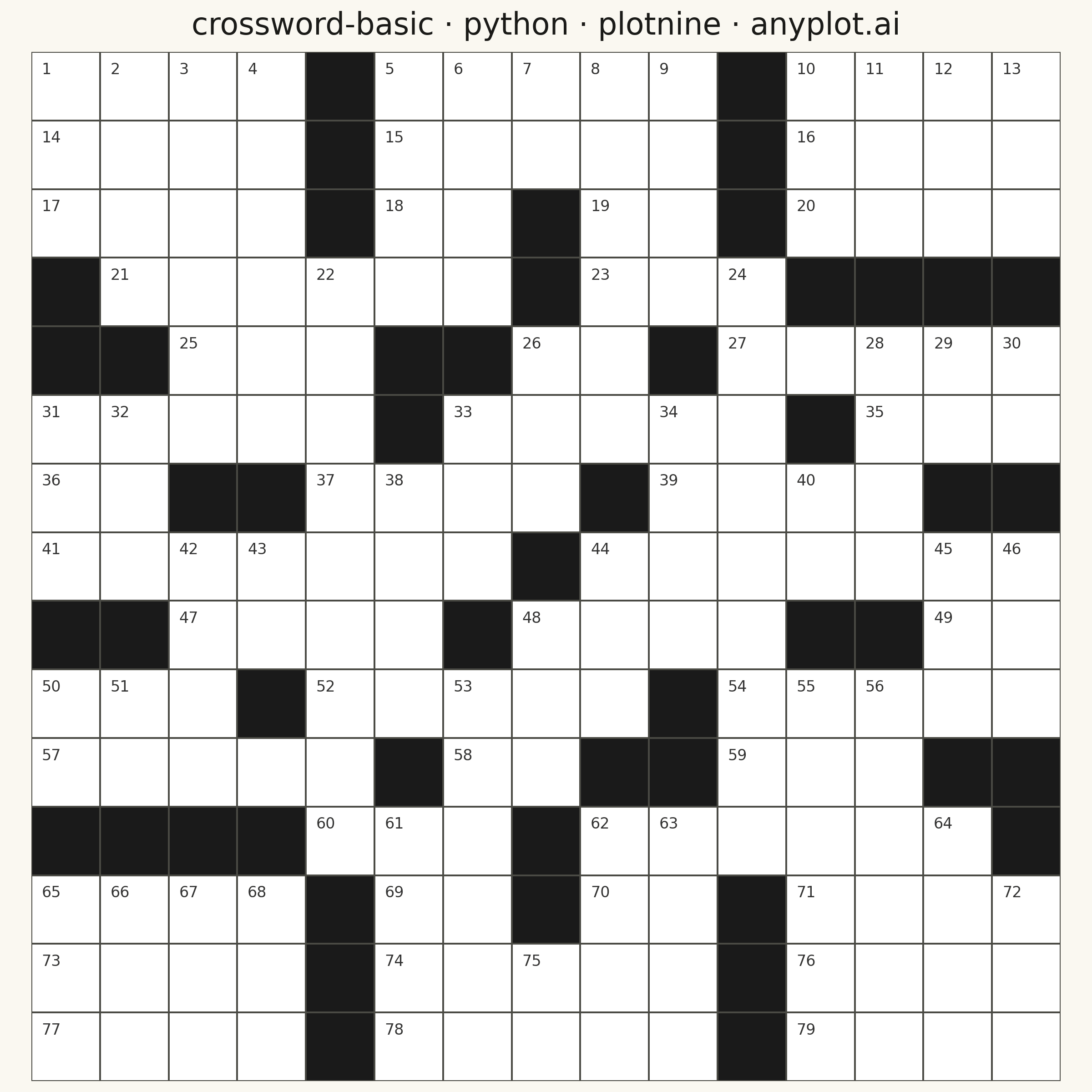
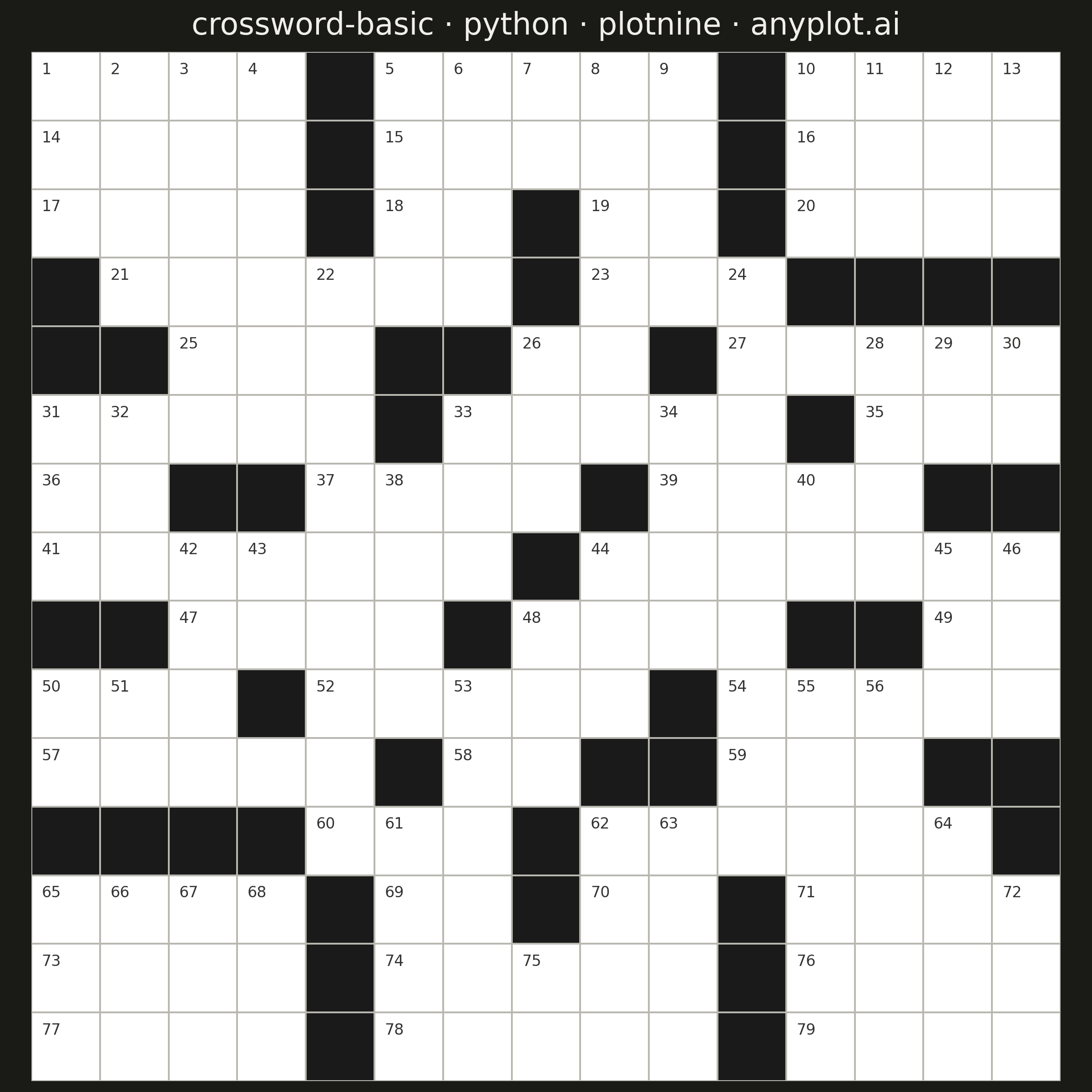
A crossword puzzle grid visualization with white entry cells for letters, black blocking cells, and numbered starting positions for across and down words. The symmetric black cell pattern follows traditional newspaper-style crossword conventions, creating a clean and recognizable puzzle layout suitable for printing or digital display.
""" anyplot.ai
crossword-basic: Crossword Puzzle Grid
Library: plotnine 0.15.4 | Python 3.13.13
Quality: 88/100 | Updated: 2026-05-20
"""

import os

import numpy as np
import pandas as pd
from plotnine import (
    aes,
    coord_fixed,
    element_blank,
    element_rect,
    element_text,
    geom_text,
    geom_tile,
    ggplot,
    labs,
    scale_fill_manual,
    scale_x_continuous,
    scale_y_continuous,
    theme,
)


THEME = os.getenv("ANYPLOT_THEME", "light")
PAGE_BG = "#FAF8F1" if THEME == "light" else "#1A1A17"
INK = "#1A1A17" if THEME == "light" else "#F0EFE8"
INK_SOFT = "#4A4A44" if THEME == "light" else "#B8B7B0"

# Create 15x15 crossword grid with 180-degree rotational symmetry
size = 15

grid = np.zeros((size, size), dtype=int)

black_positions = [
    (0, 4),
    (0, 10),
    (1, 4),
    (1, 10),
    (2, 4),
    (2, 7),
    (2, 10),
    (3, 0),
    (3, 7),
    (3, 11),
    (3, 12),
    (3, 13),
    (3, 14),
    (4, 0),
    (4, 1),
    (4, 5),
    (4, 6),
    (4, 9),
    (5, 5),
    (5, 11),
    (6, 2),
    (6, 3),
    (6, 8),
    (6, 13),
    (6, 14),
    (7, 7),
]

for r, c in black_positions:
    grid[r, c] = 1
    grid[size - 1 - r, size - 1 - c] = 1

# Build tile DataFrame
data = []
for r in range(size):
    for c in range(size):
        data.append({"col": c + 1, "row": size - r, "cell_type": "blocked" if grid[r, c] == 1 else "entry"})

df = pd.DataFrame(data)

# Determine word start positions (cells beginning an across or down word)
word_starts = {}
num = 1
for r in range(size):
    for c in range(size):
        if grid[r, c] == 1:
            continue
        starts_across = (c == 0 or grid[r, c - 1] == 1) and c < size - 1 and grid[r, c + 1] == 0
        starts_down = (r == 0 or grid[r - 1, c] == 1) and r < size - 1 and grid[r + 1, c] == 0
        if starts_across or starts_down:
            word_starts[(r, c)] = num
            num += 1

number_data = []
for (r, c), clue_num in word_starts.items():
    number_data.append({"col": c + 1, "row": size - r, "label": str(clue_num)})

numbers_df = pd.DataFrame(number_data)

# Cell fills: crossword convention — entry cells use a warm tint in light mode for visual depth
ENTRY_FILL = "#F5F3EC" if THEME == "light" else "#FFFFFF"
BLOCKED_FILL = "#1A1A1A"

plot = (
    ggplot(df, aes(x="col", y="row", fill="cell_type"))
    + geom_tile(color=INK_SOFT, size=0.4)
    + scale_fill_manual(values={"entry": ENTRY_FILL, "blocked": BLOCKED_FILL})
    + geom_text(
        data=numbers_df,
        mapping=aes(x="col", y="row", label="label"),
        size=6,
        ha="left",
        va="top",
        nudge_x=-0.35,
        nudge_y=0.35,
        color="#333333",
        inherit_aes=False,
    )
    + scale_x_continuous(breaks=[], expand=(0, 0))
    + scale_y_continuous(breaks=[], expand=(0, 0))
    + coord_fixed(ratio=1)
    + labs(
        title="crossword-basic · python · plotnine · anyplot.ai",
        subtitle="180° rotational symmetry · 79 numbered positions",
    )
    + theme(
        figure_size=(6, 6),
        plot_title=element_text(size=13, ha="center", color=INK, weight="bold"),
        plot_subtitle=element_text(size=8, ha="center", color=INK_SOFT),
        axis_text=element_blank(),
        axis_title=element_blank(),
        axis_ticks=element_blank(),
        panel_background=element_rect(fill=PAGE_BG),
        panel_border=element_rect(color=INK_SOFT, fill=None, size=0.8),
        panel_grid_major=element_blank(),
        panel_grid_minor=element_blank(),
        legend_position="none",
        plot_background=element_rect(fill=PAGE_BG, color=PAGE_BG),
        plot_margin=0.02,
    )
)

plot.save(f"plot-{THEME}.png", dpi=400, width=6, height=6, units="in")
Runnable source as JSON, for any HTTP client: https://api.anyplot.ai/specs/crossword-basic/plotnine/code. Any spec id and library id listed in llms-full.txt fit the same URL shape; every URL below is complete and callable.
{
  "spec_id": "crossword-basic",
  "language": "python",
  "library": "plotnine",
  "page": "https://anyplot.ai/crossword-basic/python/plotnine",
  "hub": "https://anyplot.ai/crossword-basic",
  "code_json": "https://api.anyplot.ai/specs/crossword-basic/plotnine/code",
  "spec_json": "https://api.anyplot.ai/specs/crossword-basic",
  "render_light_png": "https://storage.googleapis.com/anyplot-images/plots/crossword-basic/python/plotnine/plot-light.png",
  "render_dark_png": "https://storage.googleapis.com/anyplot-images/plots/crossword-basic/python/plotnine/plot-dark.png",
  "quality_score": 88.0,
  "license": "MIT",
  "guide": "https://anyplot.ai/llms.txt"
}
Part of Crossword Puzzle Grid on anyplot.ai.