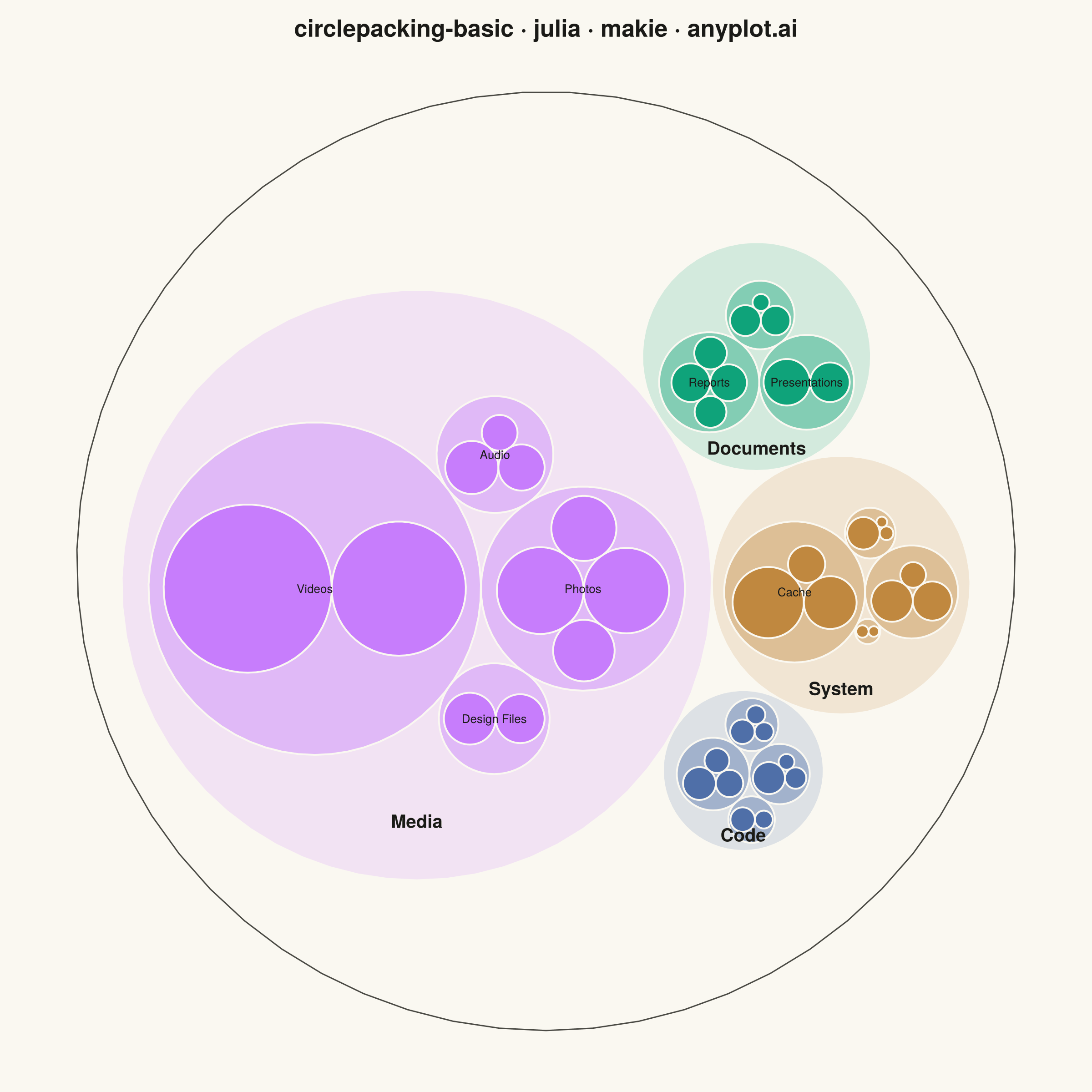
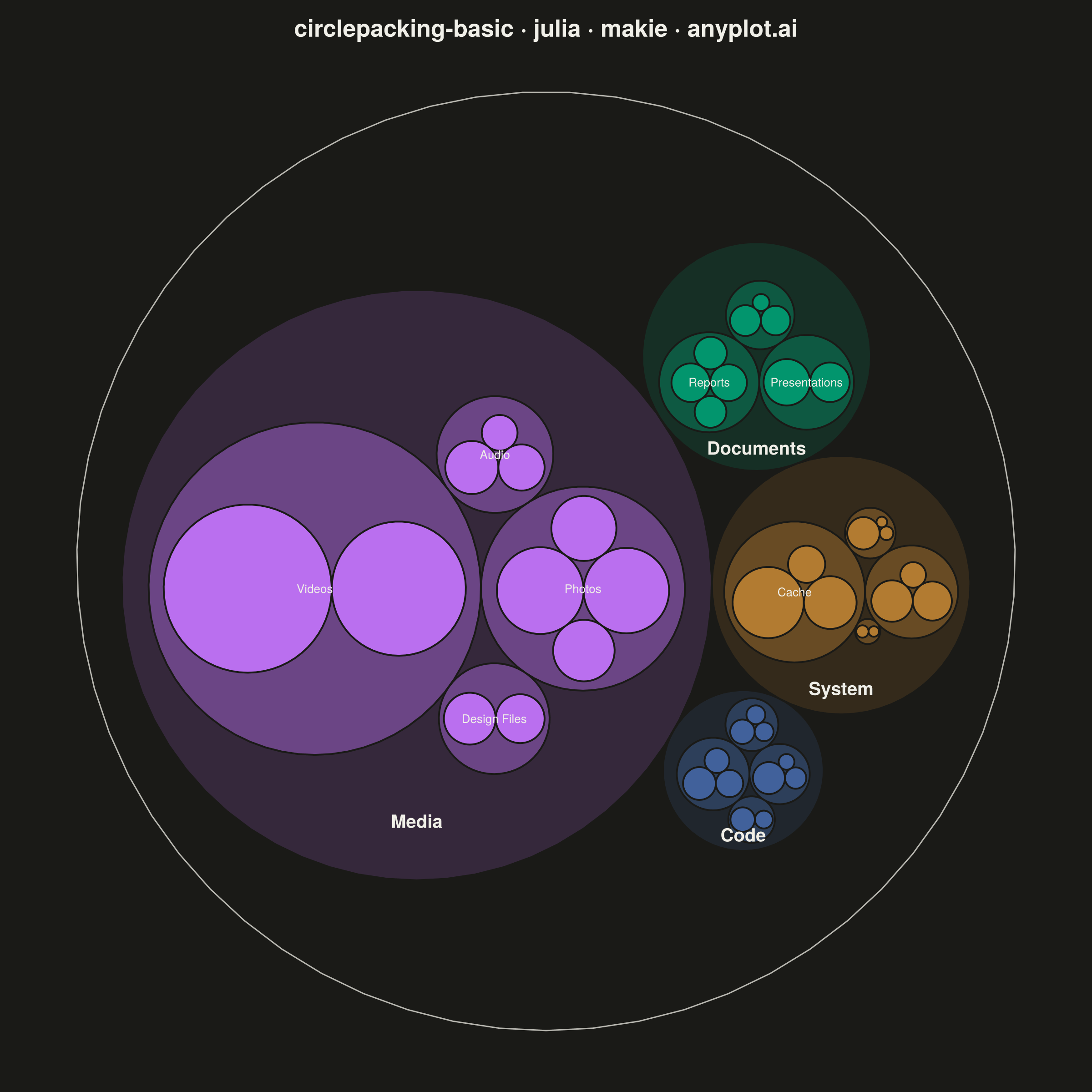
The same plot in 14 other libraries — Python: Altair, Bokeh, lets-plot, Matplotlib, Plotly, plotnine, Pygal, Seaborn; R: ggplot2; JavaScript: Chart.js, D3.js, Apache ECharts, Highcharts, MUI X Charts. Compare all 15 side by side: Circle Packing Chart in Python, R, Julia and JavaScript.
A circle packing chart displays hierarchical data as nested circles, where each circle contains smaller circles representing its children. Circle size is proportional to node value, and circles are packed efficiently without overlap. This visualization excels at revealing hierarchical structures while simultaneously showing quantitative relationships through area encoding.
# anyplot.ai
# circlepacking-basic: Circle Packing Chart
# Library: makie 0.21.9 | Julia 1.11.9
# Quality: 79/100 | Created: 2026-09-02

using CairoMakie
using Colors
using Random

Random.seed!(42)

# --- Theme tokens -------------------------------------------------------------
const THEME    = get(ENV, "ANYPLOT_THEME", "light")
const PAGE_BG  = THEME == "light" ? colorant"#FAF8F1" : colorant"#1A1A17"
const INK      = THEME == "light" ? colorant"#1A1A17" : colorant"#F0EFE8"
const INK_SOFT = THEME == "light" ? colorant"#4A4A44" : colorant"#B8B7B0"
const IMPRINT_PALETTE = [
    colorant"#009E73",  # 1 — brand green
    colorant"#C475FD",  # 2 — lavender
    colorant"#4467A3",  # 3 — blue
    colorant"#BD8233",  # 4 — ochre
]

# --- Data: disk storage broken down into folders and files --------------------
struct LeafSpec
    label::String
    size_mb::Float64
end

struct SubcatSpec
    label::String
    leaves::Vector{LeafSpec}
end

struct CategorySpec
    label::String
    subcats::Vector{SubcatSpec}
end

function random_leaves(names, lo, hi)
    return [LeafSpec(n, lo + rand() * (hi - lo)) for n in names]
end

categories = [
    CategorySpec("Documents", [
        SubcatSpec("Reports", random_leaves(["Q1", "Q2", "Q3", "Q4"], 4.0, 60.0)),
        SubcatSpec("Spreadsheets", random_leaves(["Budget", "Forecast", "Payroll"], 2.0, 40.0)),
        SubcatSpec("Presentations", random_leaves(["Kickoff", "Roadmap"], 8.0, 90.0)),
    ]),
    CategorySpec("Media", [
        SubcatSpec("Photos", random_leaves(["Trip", "Family", "Events", "Pets"], 20.0, 320.0)),
        SubcatSpec("Videos", random_leaves(["Vacation", "Tutorial"], 200.0, 1400.0)),
        SubcatSpec("Audio", random_leaves(["Podcasts", "Music", "Voice Memos"], 15.0, 260.0)),
        SubcatSpec("Design Files", random_leaves(["Logos", "Mockups"], 10.0, 150.0)),
    ]),
    CategorySpec("Code", [
        SubcatSpec("Frontend", random_leaves(["Components", "Styles", "Assets"], 3.0, 55.0)),
        SubcatSpec("Backend", random_leaves(["API", "Services", "Migrations"], 3.0, 50.0)),
        SubcatSpec("Scripts", random_leaves(["Automation", "CI"], 1.0, 20.0)),
        SubcatSpec("Tests", random_leaves(["Unit", "Integration", "Fixtures"], 1.0, 30.0)),
    ]),
    CategorySpec("System", [
        SubcatSpec("Cache", random_leaves(["Browser", "Build", "Package"], 10.0, 200.0)),
        SubcatSpec("Logs", random_leaves(["App", "Access", "Crash"], 2.0, 45.0)),
        SubcatSpec("Config", random_leaves(["User", "Network"], 0.5, 6.0)),
        SubcatSpec("Temp", random_leaves(["Downloads", "Swap", "Recovery"], 5.0, 90.0)),
    ]),
]

# --- Hierarchy node + recursive circle packing ---------------------------------
mutable struct PackNode
    label::String
    depth::Int
    value::Float64
    category_idx::Int
    children::Vector{PackNode}
    rel_x::Float64
    rel_y::Float64
    abs_x::Float64
    abs_y::Float64
    r::Float64
end

PackNode(label, depth, category_idx) =
    PackNode(label, depth, 0.0, category_idx, PackNode[], 0.0, 0.0, 0.0, 0.0, 0.0)

# Position of a circle with radius r3, externally tangent to two placed circles.
function tangent_points(x1, y1, r1, x2, y2, r2, r3)
    d = hypot(x2 - x1, y2 - y1)
    R1, R2 = r1 + r3, r2 + r3
    if d < 1e-9 || d > R1 + R2 || d < abs(R1 - R2)
        return Tuple{Float64,Float64}[]
    end
    a = (R1^2 - R2^2 + d^2) / (2d)
    h2 = R1^2 - a^2
    h2 < 0 && return Tuple{Float64,Float64}[]
    h = sqrt(h2)
    xm = x1 + a * (x2 - x1) / d
    ym = y1 + a * (y2 - y1) / d
    ux, uy = -(y2 - y1) / d, (x2 - x1) / d
    return [(xm + h * ux, ym + h * uy), (xm - h * ux, ym - h * uy)]
end

# Greedy sibling packer: places circles (by descending radius) tangent to two
# already-placed neighbors, minimizing distance from the current centroid.
function pack_siblings(radii::Vector{Float64})
    n = length(radii)
    n == 0 && return Float64[], Float64[]
    xs, ys = zeros(n), zeros(n)
    order = sortperm(radii, rev = true)
    placed = Int[order[1]]
    if n >= 2
        i2 = order[2]
        xs[i2] = radii[order[1]] + radii[i2]
        push!(placed, i2)
    end
    for k in 3:n
        i = order[k]
        r = radii[i]
        best, best_dist = nothing, Inf
        for ai in 1:length(placed), bi in (ai + 1):length(placed)
            a, b = placed[ai], placed[bi]
            for p in tangent_points(xs[a], ys[a], radii[a], xs[b], ys[b], radii[b], r)
                ok = true
                for c in placed
                    if hypot(p[1] - xs[c], p[2] - ys[c]) < radii[c] + r - 1e-6
                        ok = false
                        break
                    end
                end
                if ok
                    dist = hypot(p[1], p[2]) + r
                    if dist < best_dist
                        best_dist, best = dist, p
                    end
                end
            end
        end
        if best === nothing
            angle = 2pi * k / n
            reach = sum(radii) + r
            best = (reach * cos(angle), reach * sin(angle))
        end
        xs[i], ys[i] = best
        push!(placed, i)
    end
    return xs, ys
end

# Bottom-up: pack each node's children, then set node.r to their enclosing
# circle (plus padding) and store each child's offset relative to this node.
function pack!(node::PackNode; padding_ratio = 0.10)
    if isempty(node.children)
        node.r = sqrt(node.value)
        return
    end
    for c in node.children
        pack!(c; padding_ratio = padding_ratio)
    end
    radii = [c.r for c in node.children]
    xs, ys = pack_siblings(radii)
    lefts = xs .- radii
    rights = xs .+ radii
    tops = ys .- radii
    bottoms = ys .+ radii
    cx = (minimum(lefts) + maximum(rights)) / 2
    cy = (minimum(tops) + maximum(bottoms)) / 2
    xs .-= cx
    ys .-= cy
    enclosing_r = maximum(hypot.(xs, ys) .+ radii)
    node.r = enclosing_r * (1 + padding_ratio)
    for (c, x, y) in zip(node.children, xs, ys)
        c.rel_x, c.rel_y = x, y
    end
end

function locate!(node::PackNode, parent_x, parent_y)
    node.abs_x = parent_x + node.rel_x
    node.abs_y = parent_y + node.rel_y
    for c in node.children
        locate!(c, node.abs_x, node.abs_y)
    end
end

function collect_nodes!(node::PackNode, acc::Vector{PackNode})
    push!(acc, node)
    for c in node.children
        collect_nodes!(c, acc)
    end
end

# --- Build the tree -------------------------------------------------------------
root = PackNode("Storage", 0, 0)
for (ci, cat) in enumerate(categories)
    cat_node = PackNode(cat.label, 1, ci)
    for sub in cat.subcats
        sub_node = PackNode(sub.label, 2, ci)
        for leaf in sub.leaves
            leaf_node = PackNode(leaf.label, 3, ci)
            leaf_node.value = leaf.size_mb
            push!(sub_node.children, leaf_node)
        end
        push!(cat_node.children, sub_node)
    end
    push!(root.children, cat_node)
end

pack!(root)
root.rel_x, root.rel_y = 0.0, 0.0
locate!(root, 0.0, 0.0)

# Rescale so the root circle lands on a fixed size in figure data units.
const TARGET_ROOT_R = 540.0
scale = TARGET_ROOT_R / root.r
all_nodes = PackNode[]
collect_nodes!(root, all_nodes)
for node in all_nodes
    node.abs_x *= scale
    node.abs_y *= scale
    node.r *= scale
end

# --- Plot ------------------------------------------------------------------------
fig = Figure(
    size = (1200, 1200),
    backgroundcolor = PAGE_BG,
)

ax = Axis(
    fig[1, 1];
    title = "circlepacking-basic · julia · makie · anyplot.ai",
    titlesize = 30,
    titlecolor = INK,
    aspect = DataAspect(),
    backgroundcolor = PAGE_BG,
)
hidedecorations!(ax)
hidespines!(ax)

# Root: faint container circle showing the encompassing boundary.
poly!(ax, Circle(Point2f(root.abs_x, root.abs_y), root.r);
    color = (PAGE_BG, 0.0), strokecolor = INK_SOFT, strokewidth = 1.5)

fill_alpha = Dict(1 => 0.16, 2 => 0.38, 3 => 0.88)
for depth in 1:3
    for node in all_nodes
        node.depth == depth || continue
        base = IMPRINT_PALETTE[node.category_idx]
        poly!(ax, Circle(Point2f(node.abs_x, node.abs_y), node.r);
            color = (base, fill_alpha[depth]), strokecolor = PAGE_BG, strokewidth = 2.0)
    end
end

# Labels: categories placed just below the actual bottom of their own child
# cluster (not a fixed fraction of the category radius, which can collide
# with a child that happens to sit near the category's edge); subcategories
# at their own center, only when large relative to their own category (not
# the global root) so every category gets comparable coverage.
#
# Each tier is drawn with a single vectorized text!() call (positions/text as
# arrays) rather than one text!() per node: a per-node loop of individual
# text!() calls was silently dropping a subset of glyphs in CairoMakie even
# though their positions and the labeling threshold were correct.
category_r = Dict(node.category_idx => node.r for node in all_nodes if node.depth == 1)
label_margin = 0.05 * root.r

cat_nodes = filter(n -> n.depth == 1, all_nodes)
cat_positions = [
    Point2f(n.abs_x, minimum(c.abs_y - c.r for c in n.children) - label_margin) for
    n in cat_nodes
]
text!(ax, cat_positions; text = [n.label for n in cat_nodes],
    align = (:center, :center), fontsize = 20, color = INK, font = :bold)

sub_nodes = filter(
    n -> n.depth == 2 && n.r >= 0.18 * category_r[n.category_idx], all_nodes,
)
sub_positions = [Point2f(n.abs_x, n.abs_y) for n in sub_nodes]
text!(ax, sub_positions; text = [n.label for n in sub_nodes],
    align = (:center, :center), fontsize = 13, color = INK)

# --- Save --------------------------------------------------------------------
save("plot-$(THEME).png", fig; px_per_unit = 2)
Runnable source as JSON, for any HTTP client: https://api.anyplot.ai/specs/circlepacking-basic/makie/code. Any spec id and library id listed in llms-full.txt fit the same URL shape; every URL below is complete and callable.
{
  "spec_id": "circlepacking-basic",
  "language": "julia",
  "library": "makie",
  "page": "https://anyplot.ai/circlepacking-basic/julia/makie",
  "hub": "https://anyplot.ai/circlepacking-basic",
  "code_json": "https://api.anyplot.ai/specs/circlepacking-basic/makie/code",
  "spec_json": "https://api.anyplot.ai/specs/circlepacking-basic",
  "render_light_png": "https://storage.googleapis.com/anyplot-images/plots/circlepacking-basic/julia/makie/plot-light.png",
  "render_dark_png": "https://storage.googleapis.com/anyplot-images/plots/circlepacking-basic/julia/makie/plot-dark.png",
  "quality_score": 79.0,
  "license": "MIT",
  "guide": "https://anyplot.ai/llms.txt"
}
Part of Circle Packing Chart on anyplot.ai.