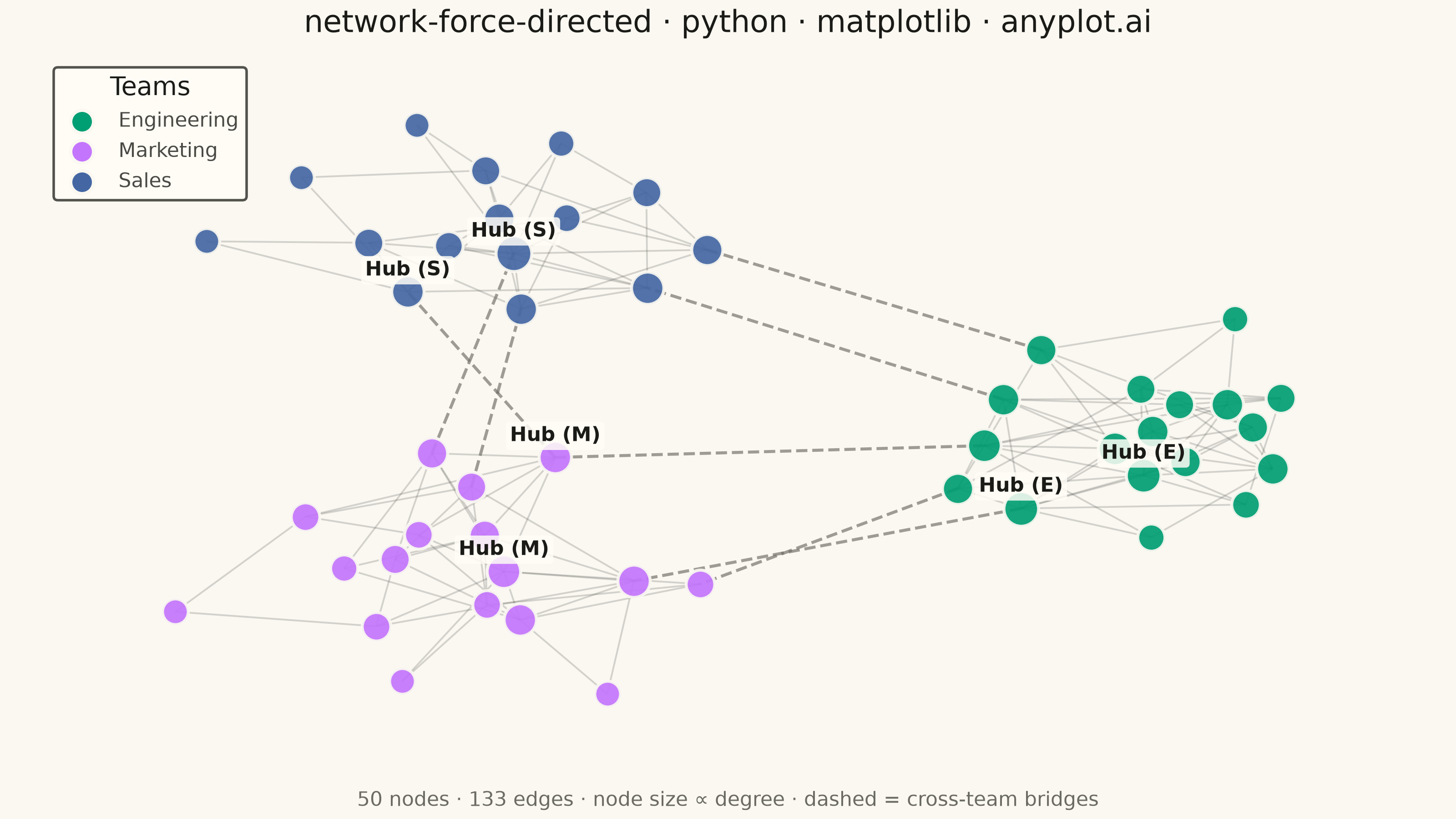
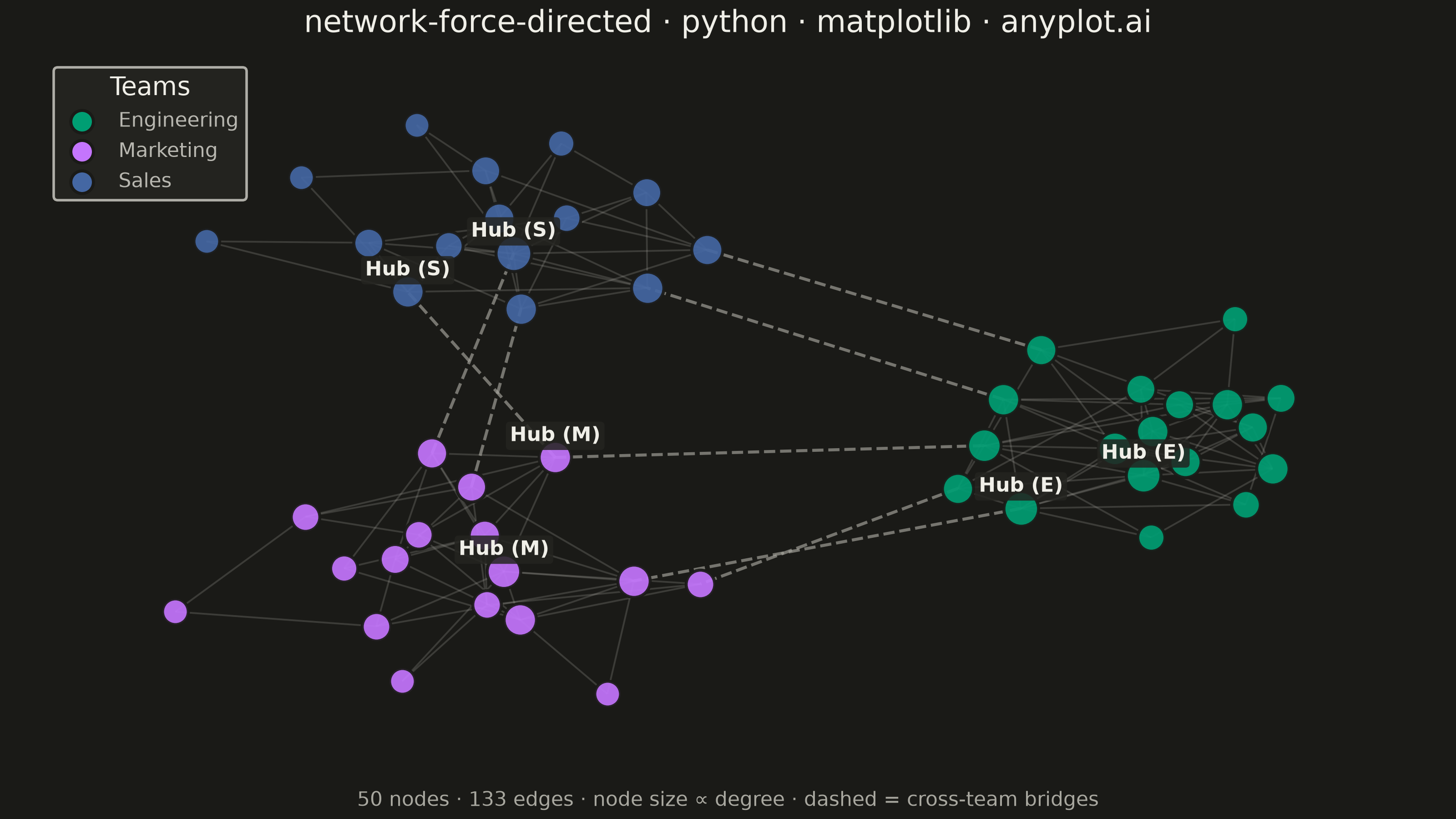
A force-directed graph uses physics simulation to position nodes, where connected nodes attract each other and all nodes repel. This creates organic layouts that naturally reveal community structure, central nodes, and overall network topology without manual positioning. The algorithm balances attractive forces (edges pulling connected nodes together) and repulsive forces (nodes pushing apart) until reaching equilibrium.
""" anyplot.ai
network-force-directed: Force-Directed Graph
Library: matplotlib 3.11.0 | Python 3.13.14
Quality: 86/100 | Updated: 2026-07-01
"""

import os
import pathlib

import matplotlib.pyplot as plt
import numpy as np
from matplotlib.collections import LineCollection


OUTPUT_DIR = pathlib.Path(__file__).parent


# Theme tokens (see prompts/default-style-guide.md)
THEME = os.getenv("ANYPLOT_THEME", "light")
PAGE_BG = "#FAF8F1" if THEME == "light" else "#1A1A17"
ELEVATED_BG = "#FFFDF6" if THEME == "light" else "#242420"
INK = "#1A1A17" if THEME == "light" else "#F0EFE8"
INK_SOFT = "#4A4A44" if THEME == "light" else "#B8B7B0"
INK_MUTED = "#6B6A63" if THEME == "light" else "#A8A79F"

# Imprint palette — first series is always #009E73
COMMUNITY_COLORS = ["#009E73", "#C475FD", "#4467A3"]
COMMUNITY_NAMES = ["Engineering", "Marketing", "Sales"]

# Data: 50-person company social network with 3 departments
np.random.seed(42)
community_sizes = [18, 17, 15]

nodes = []
nid_counter = 0
for comm_idx, size in enumerate(community_sizes):
    for _ in range(size):
        nodes.append({"id": nid_counter, "community": comm_idx})
        nid_counter += 1

intra_edges = []
ranges = [(0, 18), (18, 35), (35, 50)]
for start, stop in ranges:
    for i in range(start, stop):
        for j in range(i + 1, stop):
            if np.random.random() < 0.3:
                intra_edges.append((i, j))

# Sparse cross-department bridge edges
bridge_edges = [(0, 18), (5, 20), (10, 25), (18, 35), (22, 40), (30, 45), (8, 38), (15, 48)]
all_edges = intra_edges + bridge_edges

# Force-directed layout (Fruchterman-Reingold)
n = len(nodes)
positions = np.random.rand(n, 2) * 2 - 1
k = 0.5

for iteration in range(200):
    displacement = np.zeros((n, 2))

    for i in range(n):
        for j in range(i + 1, n):
            diff = positions[i] - positions[j]
            dist = max(np.linalg.norm(diff), 0.01)
            repulsive_force = (k * k / dist) * (diff / dist)
            displacement[i] += repulsive_force
            displacement[j] -= repulsive_force

    for src, tgt in all_edges:
        diff = positions[src] - positions[tgt]
        dist = max(np.linalg.norm(diff), 0.01)
        attractive_force = (dist * dist / k) * (diff / dist)
        displacement[src] -= attractive_force
        displacement[tgt] += attractive_force

    temperature = 1 - iteration / 200
    for i in range(n):
        disp_norm = np.linalg.norm(displacement[i])
        if disp_norm > 0:
            positions[i] += (displacement[i] / disp_norm) * min(disp_norm, 0.15 * temperature)

pos_min = positions.min(axis=0)
pos_max = positions.max(axis=0)
positions = (positions - pos_min) / (pos_max - pos_min + 1e-6) * 0.84 + 0.08
pos = {node["id"]: positions[i] for i, node in enumerate(nodes)}

degrees = {node["id"]: 0 for node in nodes}
for src, tgt in all_edges:
    degrees[src] += 1
    degrees[tgt] += 1

# Canvas: 3200×1800 px (landscape 16:9)
fig, ax = plt.subplots(figsize=(8, 4.5), dpi=400, facecolor=PAGE_BG)
ax.set_facecolor(PAGE_BG)

# Intra-community edges (solid, subtle — dense within-team connections)
intra_lines = [(pos[src], pos[tgt]) for src, tgt in intra_edges]
lc_intra = LineCollection(intra_lines, colors=INK_SOFT, linewidths=0.7, alpha=0.22, zorder=1)
ax.add_collection(lc_intra)

# Bridge edges (dashed, more visible — sparse cross-team connections reveal structure)
bridge_lines = [(pos[src], pos[tgt]) for src, tgt in bridge_edges]
lc_bridge = LineCollection(bridge_lines, colors=INK_MUTED, linewidths=1.2, alpha=0.65, linestyle="dashed", zorder=1)
ax.add_collection(lc_bridge)

# Nodes sized by degree
node_sizes = {}
for node in nodes:
    x, y = pos[node["id"]]
    degree = degrees[node["id"]]
    size = 80 + degree * 12
    node_sizes[node["id"]] = size
    color = COMMUNITY_COLORS[node["community"]]
    ax.scatter(x, y, s=size, c=color, edgecolors=PAGE_BG, linewidths=1.2, alpha=0.92, zorder=2)

# Label top 2 hubs per community
top_hubs = []
for comm_idx in range(3):
    comm_degrees = [(node["id"], degrees[node["id"]]) for node in nodes if node["community"] == comm_idx]
    comm_degrees.sort(key=lambda x: x[1], reverse=True)
    top_hubs.extend([nid for nid, _ in comm_degrees[:2]])

for node in nodes:
    nid = node["id"]
    if nid in top_hubs:
        x, y = pos[nid]
        offset = 0.008 + 0.0007 * np.sqrt(node_sizes[nid])
        team_initial = COMMUNITY_NAMES[node["community"]][0]
        ax.text(
            x,
            y + offset,
            f"Hub ({team_initial})",
            fontsize=8,
            fontweight="bold",
            ha="center",
            va="bottom",
            color=INK,
            zorder=4,
            bbox={"facecolor": ELEVATED_BG, "edgecolor": "none", "boxstyle": "round,pad=0.2", "alpha": 0.85},
        )

title = "network-force-directed · python · matplotlib · anyplot.ai"
title_fontsize = max(8, round(12 * 67 / len(title))) if len(title) > 67 else 12
ax.set_title(title, fontsize=title_fontsize, fontweight="medium", color=INK, pad=10)
ax.set_xlim(-0.02, 1.02)
ax.set_ylim(-0.02, 1.02)
ax.axis("off")

legend_handles = [
    ax.scatter([], [], c=color, s=80, edgecolors=PAGE_BG, linewidths=1.2, label=name)
    for color, name in zip(COMMUNITY_COLORS, COMMUNITY_NAMES, strict=True)
]
leg = ax.legend(
    handles=legend_handles,
    loc="upper left",
    fontsize=8,
    title="Teams",
    title_fontsize=10,
    framealpha=0.95,
    fancybox=True,
)
leg.get_frame().set_facecolor(ELEVATED_BG)
leg.get_frame().set_edgecolor(INK_SOFT)
leg.get_title().set_color(INK)
plt.setp(leg.get_texts(), color=INK_SOFT)

fig.text(
    0.5,
    0.01,
    f"50 nodes · {len(all_edges)} edges · node size ∝ degree · dashed = cross-team bridges",
    ha="center",
    va="bottom",
    fontsize=8,
    color=INK_MUTED,
)

fig.subplots_adjust(left=0.03, right=0.97, top=0.93, bottom=0.07)
plt.savefig(OUTPUT_DIR / f"plot-{THEME}.png", dpi=400, facecolor=PAGE_BG)
Runnable source as JSON, for any HTTP client: https://api.anyplot.ai/specs/network-force-directed/matplotlib/code. Any spec id and library id listed in llms-full.txt fit the same URL shape; every URL below is complete and callable.
{
  "spec_id": "network-force-directed",
  "language": "python",
  "library": "matplotlib",
  "page": "https://anyplot.ai/network-force-directed/python/matplotlib",
  "hub": "https://anyplot.ai/network-force-directed",
  "code_json": "https://api.anyplot.ai/specs/network-force-directed/matplotlib/code",
  "spec_json": "https://api.anyplot.ai/specs/network-force-directed",
  "render_light_png": "https://storage.googleapis.com/anyplot-images/plots/network-force-directed/python/matplotlib/plot-light.png",
  "render_dark_png": "https://storage.googleapis.com/anyplot-images/plots/network-force-directed/python/matplotlib/plot-dark.png",
  "quality_score": 86.0,
  "license": "MIT",
  "guide": "https://anyplot.ai/llms.txt"
}
Part of Force-Directed Graph on anyplot.ai.