The same plot in 14 other libraries — JavaScript: Chart.js, Apache ECharts, Highcharts, MUI X Charts; Python: Altair, Bokeh, lets-plot, Matplotlib, Plotly, plotnine, Pygal, Seaborn; R: ggplot2; Julia: Makie.jl. Compare all 15 side by side: Phylogenetic Tree Diagram in Python, R, Julia and JavaScript.
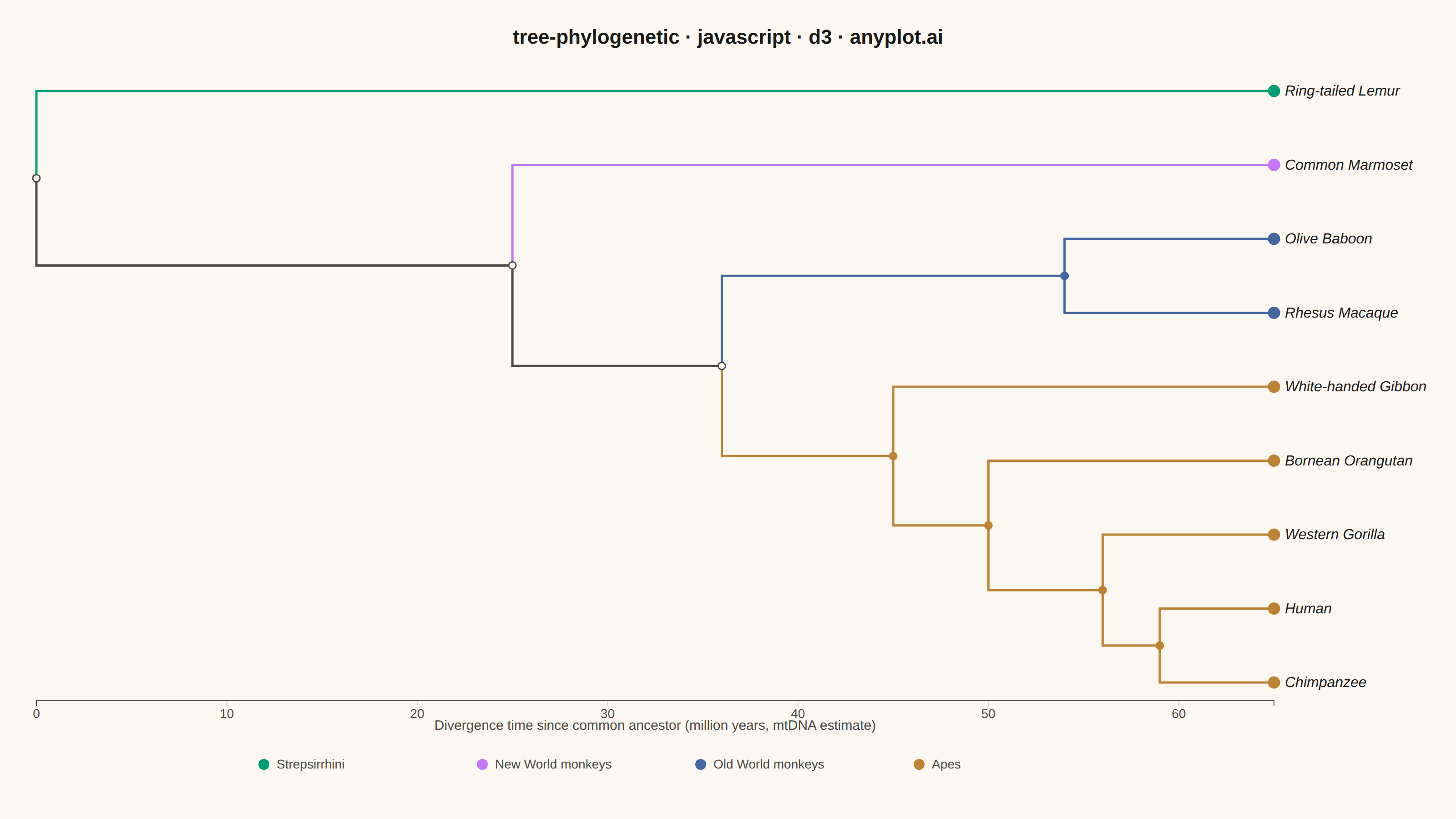
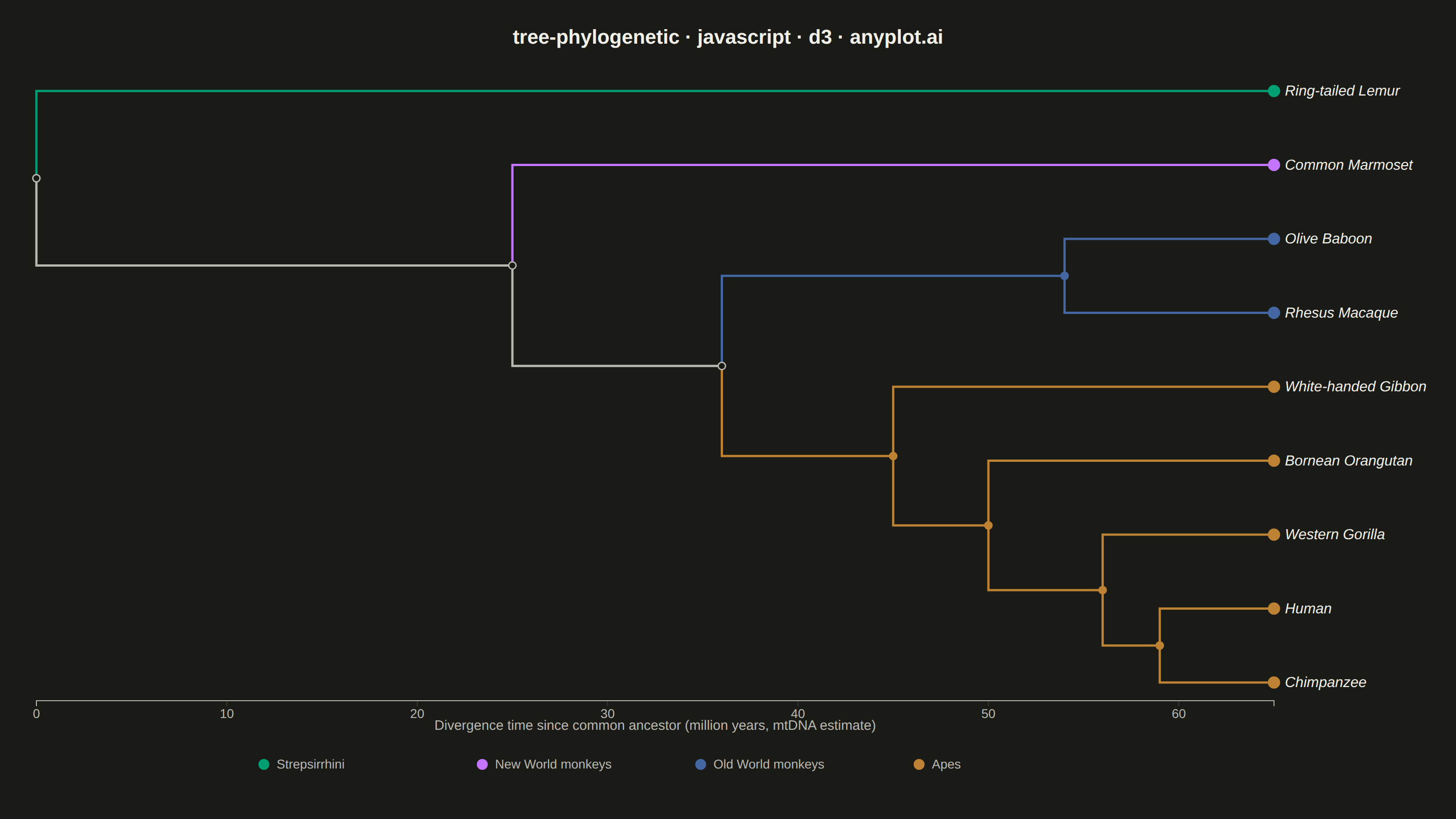
A phylogenetic tree (evolutionary tree) visualization showing hierarchical relationships between species or sequences, with branch lengths proportional to evolutionary distance. This diagram reveals how organisms or genes evolved from common ancestors, with longer branches indicating greater divergence. Phylogenetic trees are essential for understanding evolutionary history, taxonomy, and molecular biology relationships.
// anyplot.ai
// tree-phylogenetic: Phylogenetic Tree Diagram
// Library: d3 7.9.0 | JavaScript 22.23.2
// Quality: 93/100 | Created: 2026-09-09

const t = window.ANYPLOT_TOKENS;
const { width, height } = window.ANYPLOT_SIZE;
const margin = { top: 100, right: 200, bottom: 150, left: 40 };
const iw = width - margin.left - margin.right;
const ih = height - margin.top - margin.bottom;

// --- Data: primate phylogeny from mitochondrial-DNA divergence estimates ---
// Each `length` is the branch length in millions of years (Mya) since the
// parent node split off — an ultrametric tree, so every tip lines up at the
// same cumulative distance from the common ancestor (a molecular-clock read).
const tree = {
  name: "Common ancestor",
  children: [
    { name: "Ring-tailed Lemur", length: 65, clade: 0 },
    {
      name: "Anthropoidea",
      length: 25,
      children: [
        { name: "Common Marmoset", length: 40, clade: 1 },
        {
          name: "Catarrhini",
          length: 11,
          children: [
            {
              name: "Cercopithecidae",
              length: 18,
              children: [
                { name: "Olive Baboon", length: 11, clade: 2 },
                { name: "Rhesus Macaque", length: 11, clade: 2 },
              ],
            },
            {
              name: "Hominoidea",
              length: 9,
              children: [
                { name: "White-handed Gibbon", length: 20, clade: 3 },
                {
                  name: "Hominidae",
                  length: 5,
                  children: [
                    { name: "Bornean Orangutan", length: 15, clade: 3 },
                    {
                      name: "Homininae",
                      length: 6,
                      children: [
                        { name: "Western Gorilla", length: 9, clade: 3 },
                        {
                          name: "Homo/Pan",
                          length: 3,
                          children: [
                            { name: "Human", length: 6, clade: 3 },
                            { name: "Chimpanzee", length: 6, clade: 3 },
                          ],
                        },
                      ],
                    },
                  ],
                },
              ],
            },
          ],
        },
      ],
    },
  ],
};

const CLADE_NAMES = ["Strepsirrhini", "New World monkeys", "Old World monkeys", "Apes"];
const cladeColor = d3.scaleOrdinal().domain([0, 1, 2, 3]).range(t.palette.slice(0, 4));

// --- Hierarchy + phylogram layout -------------------------------------------
const root = d3.hierarchy(tree, (d) => d.children);

// cumulative branch length (Mya since the common ancestor); each.() visits
// in breadth-first order, so a parent's len is always set before its children
root.each((d) => {
  d.len = d.parent ? d.parent.len + d.data.length : 0;
});

// leaves evenly spaced top-to-bottom in traversal order
const leaves = root.leaves();
leaves.forEach((d, i) => {
  d.py = (i / (leaves.length - 1)) * ih;
});
// internal nodes settle at the midpoint of their children (post-order)
root.eachAfter((d) => {
  if (d.children) d.py = d3.mean(d.children, (c) => c.py);
});

// a node inherits a clade color only if every descendant shares one clade —
// this keeps the deep backbone branches neutral and highlights each clade
root.eachAfter((d) => {
  if (!d.children) {
    d.clade = d.data.clade;
  } else {
    const clades = new Set(d.children.map((c) => c.clade));
    d.clade = clades.size === 1 ? [...clades][0] : null;
  }
});

const maxLen = d3.max(root.descendants(), (d) => d.len);
const x = d3.scaleLinear().domain([0, maxLen]).range([0, iw]);

// --- SVG mount ---------------------------------------------------------------
const svg = d3.select("#container").append("svg").attr("width", width).attr("height", height);
const g = svg.append("g").attr("transform", `translate(${margin.left},${margin.top})`);

// --- Branches: elbow links (vertical at the parent's age, then horizontal) --
g.selectAll("path.branch")
  .data(root.links())
  .join("path")
  .attr("class", "branch")
  .attr("fill", "none")
  .attr("stroke", (d) => (d.target.clade !== null ? cladeColor(d.target.clade) : t.inkSoft))
  .attr("stroke-width", 2.5)
  .attr("d", (d) => `M${x(d.source.len)},${d.source.py} V${d.target.py} H${x(d.target.len)}`);

// --- Nodes ---------------------------------------------------------------------
const nodes = g
  .selectAll("g.node")
  .data(root.descendants())
  .join("g")
  .attr("class", "node")
  .attr("transform", (d) => `translate(${x(d.len)},${d.py})`);

nodes
  .append("circle")
  .attr("r", (d) => (d.children ? 4 : 6))
  .attr("fill", (d) => (d.clade !== null ? cladeColor(d.clade) : t.pageBg))
  .attr("stroke", (d) => (d.clade !== null ? cladeColor(d.clade) : t.inkSoft))
  .attr("stroke-width", 1.5);

// --- Leaf labels (species names, italicized per taxonomic convention) -------
nodes
  .filter((d) => !d.children)
  .append("text")
  .attr("x", 12)
  .attr("dy", "0.32em")
  .style("font-size", "16px")
  .style("font-style", "italic")
  .attr("fill", t.ink)
  .text((d) => d.data.name);

// --- X axis: divergence time (doubles as the branch-length scale bar) -------
const xAxis = g
  .append("g")
  .attr("transform", `translate(0,${ih + 20})`)
  .call(d3.axisBottom(x).ticks(6));
xAxis.selectAll("text").attr("fill", t.inkSoft).style("font-size", "14px");
xAxis.selectAll("line").attr("stroke", t.grid);
xAxis.select(".domain").attr("stroke", t.inkSoft);

g.append("text")
  .attr("x", iw / 2)
  .attr("y", ih + 52)
  .attr("text-anchor", "middle")
  .attr("fill", t.inkSoft)
  .style("font-size", "15px")
  .text("Divergence time since common ancestor (million years, mtDNA estimate)");

// --- Clade legend --------------------------------------------------------------
const legendSpacing = 240;
const legendStartX = (iw - legendSpacing * (CLADE_NAMES.length - 1)) / 2 - 70;
const legend = g.append("g").attr("transform", `translate(${legendStartX},${ih + 90})`);
CLADE_NAMES.forEach((name, i) => {
  const item = legend.append("g").attr("transform", `translate(${i * legendSpacing},0)`);
  item.append("circle").attr("r", 6).attr("fill", cladeColor(i));
  item
    .append("text")
    .attr("x", 14)
    .attr("dy", "0.32em")
    .attr("fill", t.inkSoft)
    .style("font-size", "14px")
    .text(name);
});

// --- Title --------------------------------------------------------------------
svg
  .append("text")
  .attr("x", width / 2)
  .attr("y", 48)
  .attr("text-anchor", "middle")
  .attr("fill", t.ink)
  .style("font-size", "22px")
  .style("font-weight", "600")
  .text("tree-phylogenetic · javascript · d3 · anyplot.ai");
Runnable source as JSON, for any HTTP client: https://api.anyplot.ai/specs/tree-phylogenetic/d3/code. Any spec id and library id listed in llms-full.txt fit the same URL shape; every URL below is complete and callable.
{
  "spec_id": "tree-phylogenetic",
  "language": "javascript",
  "library": "d3",
  "page": "https://anyplot.ai/tree-phylogenetic/javascript/d3",
  "hub": "https://anyplot.ai/tree-phylogenetic",
  "code_json": "https://api.anyplot.ai/specs/tree-phylogenetic/d3/code",
  "spec_json": "https://api.anyplot.ai/specs/tree-phylogenetic",
  "render_light_png": "https://storage.googleapis.com/anyplot-images/plots/tree-phylogenetic/javascript/d3/plot-light.png",
  "render_dark_png": "https://storage.googleapis.com/anyplot-images/plots/tree-phylogenetic/javascript/d3/plot-dark.png",
  "interactive_light_html": "https://storage.googleapis.com/anyplot-images/plots/tree-phylogenetic/javascript/d3/plot-light.html",
  "interactive_dark_html": "https://storage.googleapis.com/anyplot-images/plots/tree-phylogenetic/javascript/d3/plot-dark.html",
  "quality_score": 93.0,
  "license": "MIT",
  "guide": "https://anyplot.ai/llms.txt"
}
Part of Phylogenetic Tree Diagram on anyplot.ai.