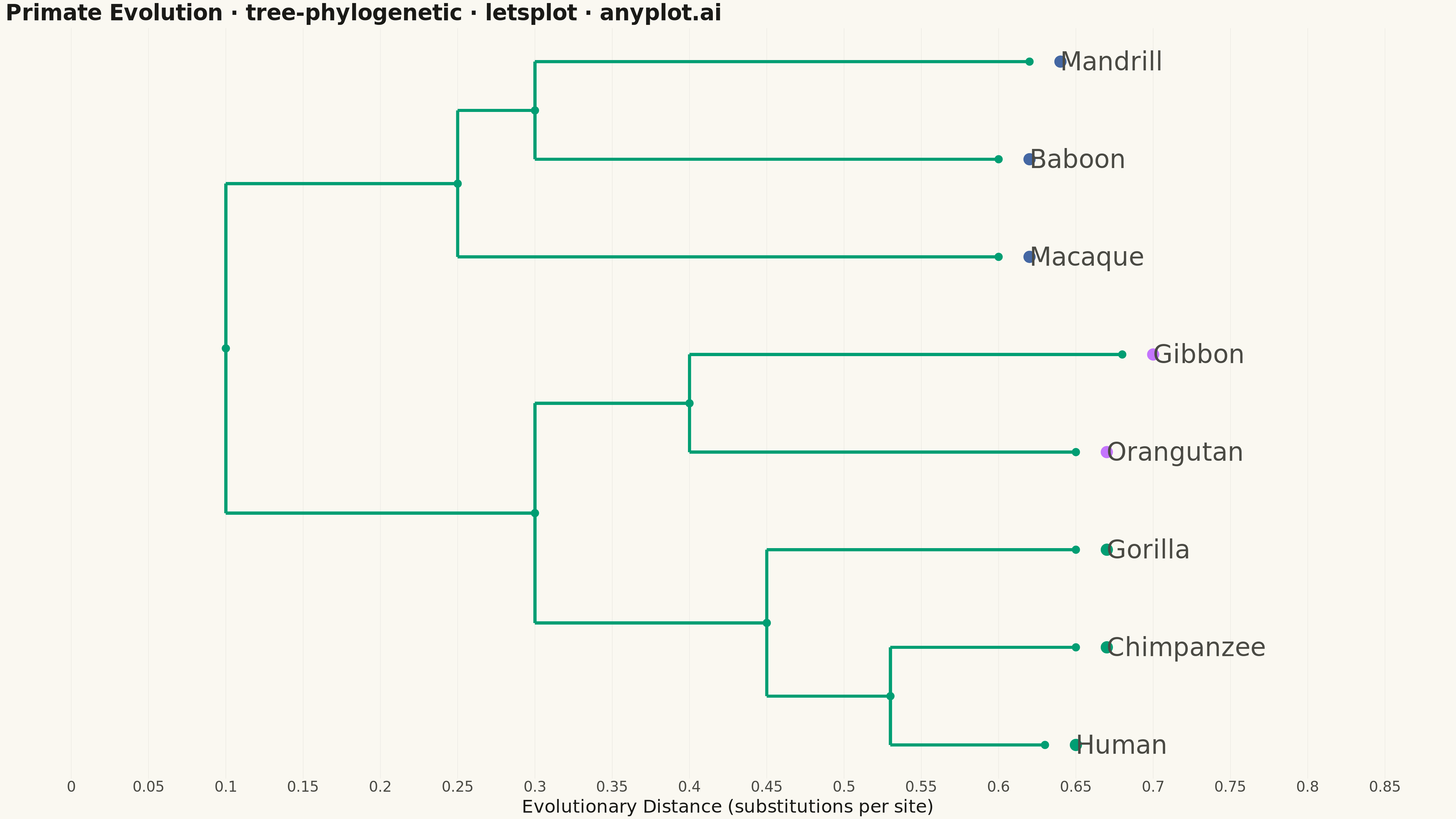
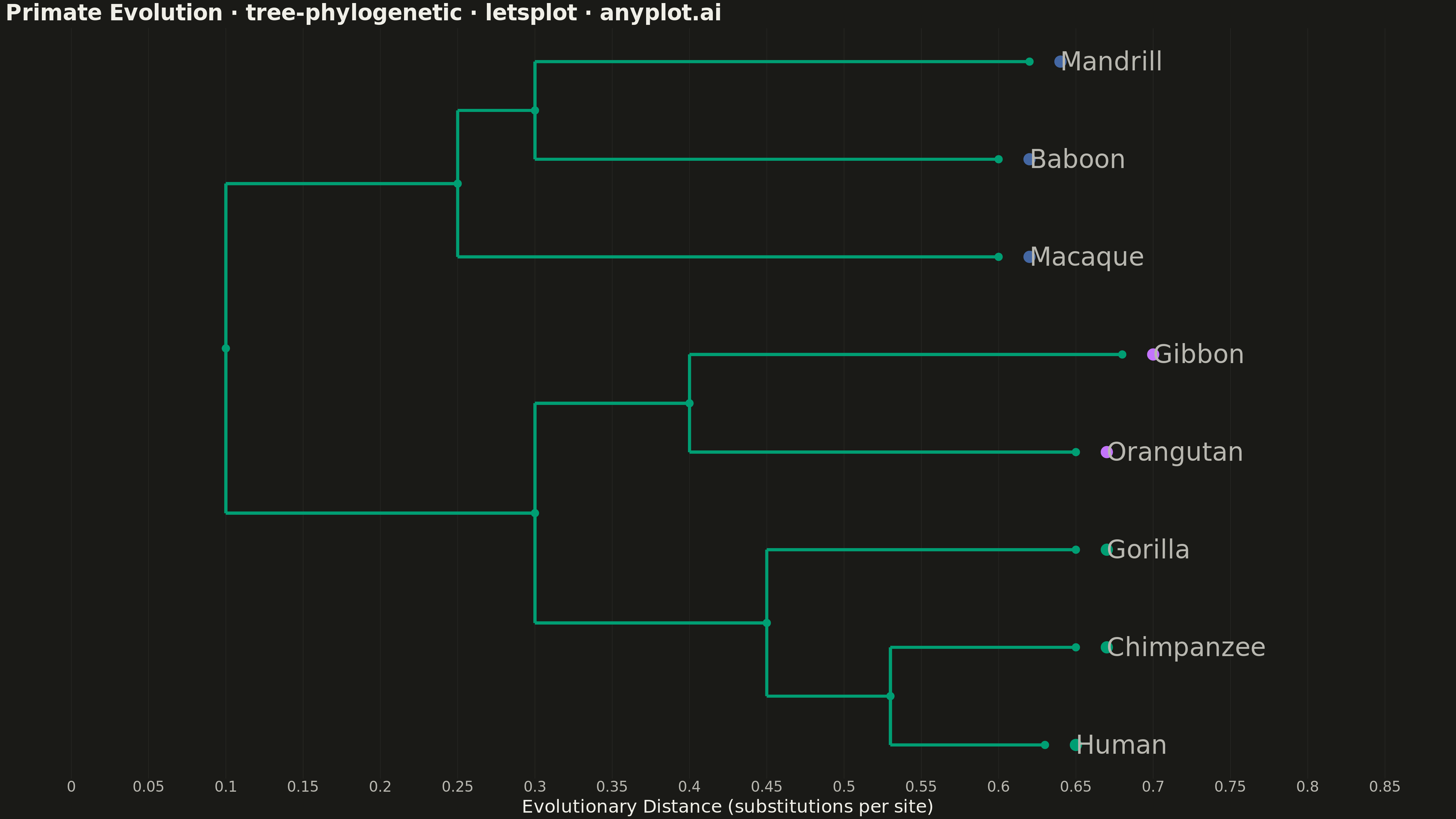
A phylogenetic tree (evolutionary tree) visualization showing hierarchical relationships between species or sequences, with branch lengths proportional to evolutionary distance. This diagram reveals how organisms or genes evolved from common ancestors, with longer branches indicating greater divergence. Phylogenetic trees are essential for understanding evolutionary history, taxonomy, and molecular biology relationships.
""" anyplot.ai
tree-phylogenetic: Phylogenetic Tree Diagram
Library: letsplot 4.9.0 | Python 3.13.13
Quality: 93/100 | Updated: 2026-05-15
"""

import os
import re

import pandas as pd
from lets_plot import *


LetsPlot.setup_html()

THEME = os.getenv("ANYPLOT_THEME", "light")
PAGE_BG = "#FAF8F1" if THEME == "light" else "#1A1A17"
ELEVATED_BG = "#FFFDF6" if THEME == "light" else "#242420"
INK = "#1A1A17" if THEME == "light" else "#F0EFE8"
INK_SOFT = "#4A4A44" if THEME == "light" else "#B8B7B0"
GRID_COLOR = "rgba(26,26,23,0.10)" if THEME == "light" else "rgba(240,239,232,0.10)"

IMPRINT = ["#009E73", "#C475FD", "#4467A3", "#BD8233", "#AE3030", "#2ABCCD", "#954477"]


def parse_newick(newick_str):
    """Parse Newick format string into tree structure."""
    newick_str = newick_str.strip().rstrip(";")
    node_id = [0]

    def parse_node(s, parent_id=None, depth=0):
        nodes = []
        s = s.strip()

        if "(" not in s:
            match = re.match(r"([^:]*):?([\d.]*)", s)
            name = match.group(1) if match else s
            length = float(match.group(2)) if match and match.group(2) else 0.1
            node_id[0] += 1
            return [
                {"id": node_id[0], "name": name, "length": length, "parent": parent_id, "depth": depth, "children": []}
            ]

        if s.startswith("("):
            level = 0
            children_str = ""
            remaining = ""
            for i, c in enumerate(s):
                if c == "(":
                    level += 1
                elif c == ")":
                    level -= 1
                    if level == 0:
                        children_str = s[1:i]
                        remaining = s[i + 1 :]
                        break

            match = re.match(r":?([\d.]*)", remaining)
            length = float(match.group(1)) if match and match.group(1) else 0.1

            node_id[0] += 1
            current_id = node_id[0]
            current_node = {
                "id": current_id,
                "name": "",
                "length": length,
                "parent": parent_id,
                "depth": depth,
                "children": [],
            }
            nodes.append(current_node)

            children = []
            level = 0
            current = ""
            for c in children_str:
                if c == "(":
                    level += 1
                elif c == ")":
                    level -= 1
                if c == "," and level == 0:
                    children.append(current.strip())
                    current = ""
                else:
                    current += c
            if current.strip():
                children.append(current.strip())

            for child_str in children:
                child_nodes = parse_node(child_str, current_id, depth + 1)
                nodes.extend(child_nodes)
                current_node["children"].extend([n["id"] for n in child_nodes if n["parent"] == current_id])

        return nodes

    return parse_node(newick_str)


newick = "((((Human:0.1,Chimpanzee:0.12):0.08,Gorilla:0.2):0.15,(Orangutan:0.25,Gibbon:0.28):0.1):0.2,(Macaque:0.35,(Baboon:0.3,Mandrill:0.32):0.05):0.15)"

nodes = parse_newick(newick)

node_dict = {n["id"]: n for n in nodes}


def calc_x_positions(node_dict):
    root = [n for n in node_dict.values() if n["parent"] is None][0]

    def assign_x(node_id, parent_x=0):
        node = node_dict[node_id]
        node["x"] = parent_x + node["length"]
        for child_id in node["children"]:
            assign_x(child_id, node["x"])

    assign_x(root["id"], 0)


def calc_y_positions(node_dict):
    leaves = [n for n in node_dict.values() if not n["children"]]
    leaves.sort(key=lambda n: n["id"])

    for i, leaf in enumerate(leaves):
        leaf["y"] = i

    def get_y(node_id):
        node = node_dict[node_id]
        if "y" in node:
            return node["y"]
        child_ys = [get_y(cid) for cid in node["children"]]
        node["y"] = sum(child_ys) / len(child_ys)
        return node["y"]

    for node in node_dict.values():
        get_y(node["id"])


calc_x_positions(node_dict)
calc_y_positions(node_dict)

segments = []
for node in node_dict.values():
    if node["parent"] is not None:
        parent = node_dict[node["parent"]]
        segments.append({"x": parent["x"], "xend": node["x"], "y": node["y"], "yend": node["y"], "type": "horizontal"})
        segments.append(
            {"x": parent["x"], "xend": parent["x"], "y": parent["y"], "yend": node["y"], "type": "vertical"}
        )

df_segments = pd.DataFrame(segments)

leaves = [n for n in node_dict.values() if not n["children"]]
df_labels = pd.DataFrame([{"x": n["x"] + 0.02, "y": n["y"], "label": n["name"]} for n in leaves])

df_nodes = pd.DataFrame([{"x": n["x"], "y": n["y"]} for n in node_dict.values()])

clade_colors = {
    "Human": IMPRINT[0],
    "Chimpanzee": IMPRINT[0],
    "Gorilla": IMPRINT[0],
    "Orangutan": IMPRINT[1],
    "Gibbon": IMPRINT[1],
    "Macaque": IMPRINT[2],
    "Baboon": IMPRINT[2],
    "Mandrill": IMPRINT[2],
}

df_labels["color"] = df_labels["label"].map(clade_colors)

anyplot_theme = theme(
    plot_background=element_rect(fill=PAGE_BG, color=PAGE_BG),
    panel_background=element_rect(fill=PAGE_BG, color=PAGE_BG),
    panel_grid_major_x=element_line(color=GRID_COLOR, size=0.3),
    panel_grid_major_y=element_blank(),
    panel_grid_minor=element_blank(),
    axis_title_x=element_text(size=20, color=INK),
    axis_title_y=element_blank(),
    axis_text_x=element_text(size=16, color=INK_SOFT),
    axis_text_y=element_blank(),
    axis_ticks_y=element_blank(),
    axis_line_y=element_blank(),
    plot_title=element_text(size=24, face="bold", color=INK),
    legend_background=element_rect(fill=ELEVATED_BG, color=INK_SOFT),
    legend_text=element_text(size=16, color=INK_SOFT),
)

plot = (
    ggplot()
    + geom_segment(aes(x="x", y="y", xend="xend", yend="yend"), data=df_segments, color=IMPRINT[0], size=1.5)
    + geom_point(aes(x="x", y="y"), data=df_nodes, color=IMPRINT[0], size=4)
    + geom_point(aes(x="x", y="y", color="color"), data=df_labels, size=6, show_legend=False)
    + geom_text(aes(x="x", y="y", label="label"), data=df_labels, hjust=0, size=14, color=INK_SOFT, family="sans-serif")
    + scale_color_identity()
    + scale_x_continuous(limits=[0, 0.85])
    + labs(
        title="Primate Evolution · tree-phylogenetic · letsplot · anyplot.ai",
        x="Evolutionary Distance (substitutions per site)",
    )
    + theme_minimal()
    + anyplot_theme
    + ggsize(1600, 900)
)

ggsave(plot, f"plot-{THEME}.png", path=".", scale=3)
ggsave(plot, f"plot-{THEME}.html", path=".")
Runnable source as JSON, for any HTTP client: https://api.anyplot.ai/specs/tree-phylogenetic/letsplot/code. Any spec id and library id listed in llms-full.txt fit the same URL shape; every URL below is complete and callable.
{
  "spec_id": "tree-phylogenetic",
  "language": "python",
  "library": "letsplot",
  "page": "https://anyplot.ai/tree-phylogenetic/python/letsplot",
  "hub": "https://anyplot.ai/tree-phylogenetic",
  "code_json": "https://api.anyplot.ai/specs/tree-phylogenetic/letsplot/code",
  "spec_json": "https://api.anyplot.ai/specs/tree-phylogenetic",
  "render_light_png": "https://storage.googleapis.com/anyplot-images/plots/tree-phylogenetic/python/letsplot/plot-light.png",
  "render_dark_png": "https://storage.googleapis.com/anyplot-images/plots/tree-phylogenetic/python/letsplot/plot-dark.png",
  "interactive_light_html": "https://storage.googleapis.com/anyplot-images/plots/tree-phylogenetic/python/letsplot/plot-light.html",
  "interactive_dark_html": "https://storage.googleapis.com/anyplot-images/plots/tree-phylogenetic/python/letsplot/plot-dark.html",
  "quality_score": 93.0,
  "license": "MIT",
  "guide": "https://anyplot.ai/llms.txt"
}
Part of Phylogenetic Tree Diagram on anyplot.ai.